
10 PPC Management Tools for Multi-Account Teams
Compare 10 ppc management tools for multi-account teams, including agent integrations, cross-channel workflows, pricing models, and limitations.
- ppc management tools
- PPC automation
- multi-account PPC
- ad management software
- PPC platforms
PPC management tools are often chosen as if they were a better dashboard. That’s the wrong test. A dashboard can show that a campaign is wasting budget, but the operational question is whether the software can recommend a change, execute it safely, record what happened, and repeat the workflow across every relevant account.
The useful comparison is therefore less about feature counts and more about what each platform can change. Does it control Google Ads, Microsoft Advertising, Meta, TikTok, or retail media? Does it offer rules, recommendations, creative production, agent-connected execution, or enterprise governance? Does pricing grow with spend, seats, accounts, or a custom contract?
This list compares the tools by operational role. AdCrunch is the strongest fit for teams seeking agent-connected execution across multiple accounts, particularly when auditable Meta changes and flat organization pricing matter. The other platforms are better suited to focused search optimization, creative-scale workflows, enterprise buying, cross-channel reporting, or granular rules. The right choice depends on where your team loses time and how much control you’re willing to delegate.
Table of Contents
- 1. AdCrunch
- 2. Optmyzr
- 3. Adalysis
- 4. Opteo
- 5. Skai
- 6. Search Ads 360
- 7. MarinOne
- 8. Smartly.io
- 9. Madgicx
- 10. Birch
- Top 10 PPC Management Tools: Feature & Performance Comparison
- Choose the Workflow That Matches Your Scale
1. AdCrunch
AdCrunch is built for the part of PPC work that most dashboards leave unfinished: turning a diagnosis into an operational change. Teams can connect Meta, TikTok, and Google Ads, then use Claude, ChatGPT, Cursor, or the built-in Adgent to ask performance questions and work from live account data. The important distinction is that the system isn’t limited to reporting. On Meta, an agent can move budgets, pause or resume entities, and build campaigns, ad sets, creatives, and ads.
That write scope is deliberately constrained. AdCrunch doesn’t hard-delete entities, change targeting on existing ad sets, or edit bids. New creations arrive paused, which prevents an agent from creating immediate spend without review. Every action is captured on a permanent Activity page with the account, change details, request origin, and outcome.
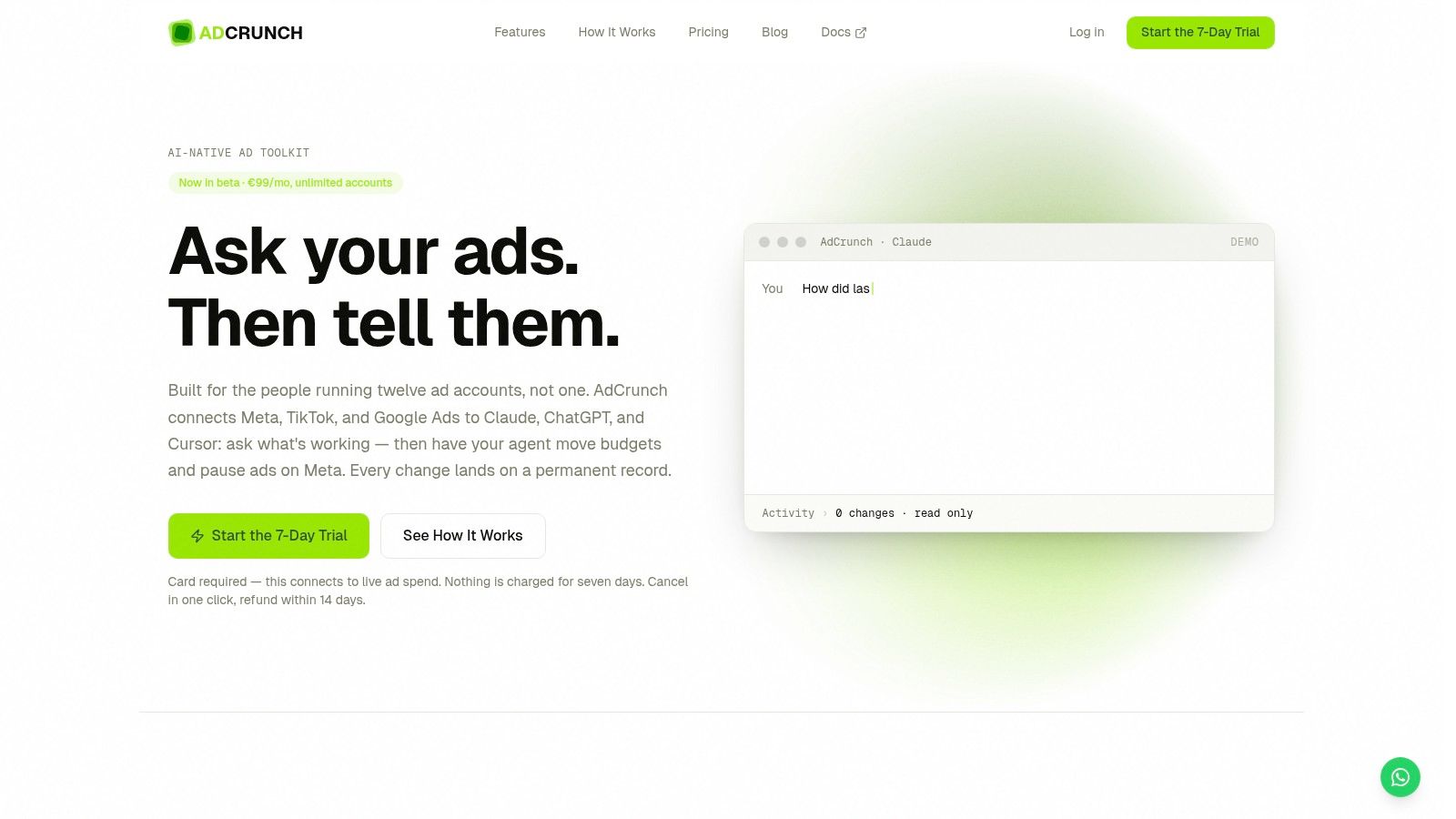
Best fit for agent-connected ad operations
The strongest workflow is the connection between live data, an agent, and controlled execution. Skills and Brands let teams encode playbooks, operating rules, and brand guidelines that the agent reads before acting. Campaign Plans keep structured planning and launch activity in one synchronized document, rather than splitting the brief, build, and implementation across separate tools.
Credentials remain with AdCrunch and aren’t exposed to the connected language models. Actions run server-side against the connected advertising platforms, which gives teams a clearer security boundary than pasting account data or credentials into an external assistant.
The trade-off is important. Meta has write access, while TikTok and Google Ads are read-only for now. That makes AdCrunch a strong operational layer for multi-network diagnosis and Meta execution, but not a complete replacement for native campaign builders on every channel.
Pricing behavior
Pro costs €99 per month as a flat organization fee, with unlimited ad accounts and seats, according to the AdCrunch website. That structure is especially relevant to agencies, freelancers, and multi-brand teams that don’t want each new account or user to add another software charge. Enterprise adds SSO, SLA, and custom integrations. A 7-day trial is available with a card required, and the product is presented as beta on its website.
The flat model won’t be the best value for a single-account operator. It becomes more compelling as account volume and collaboration increase, provided Meta write execution is central to the workflow.
2. Optmyzr
Optmyzr is a mature choice for agencies and in-house teams managing Google Ads and Microsoft Advertising at scale. Its operational role is the rules-and-recommendations layer. Instead of asking an agent to make a broad judgment, practitioners configure structured optimizations around budgets, bids, search terms, Shopping, pacing, and waste reduction.
That approach works well when the team already knows the conditions it wants to enforce. A manager can create repeatable workflows for budget pacing, account audits, and optimization reviews, then use cross-account views to spot exceptions without opening every native interface. Shareable dashboards also make client reporting easier for agencies.
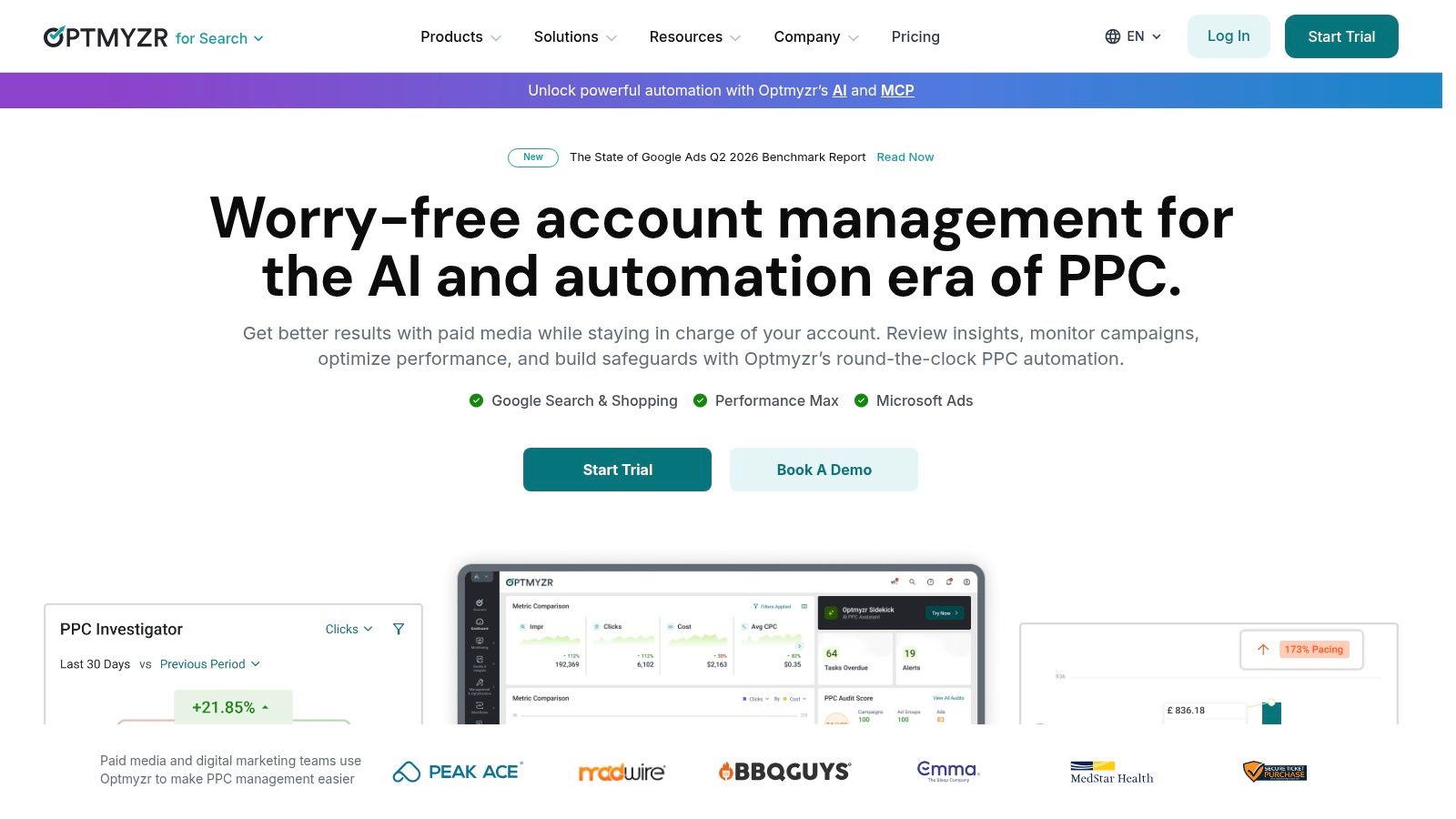
The advantage is control and depth within search. The weakness is coverage. Teams running substantial Meta or TikTok operations will need another system, because Optmyzr’s strongest workflows remain concentrated around search advertising. It also takes time to configure well. A large rule library can create more operational noise if nobody owns the logic, reviews exceptions, and documents why an automation exists.
Practical rule: Build a small set of tested optimizations first. A complicated rule engine doesn’t help if nobody can explain which conditions trigger a change.
Optmyzr makes sense when the bottleneck is repetitive Google or Microsoft work, not when the team needs one agent to coordinate execution across social and search. Agencies comparing operational layers may also benefit from this guide to ad operations tools. Visit the Optmyzr platform to assess its current agency workflows and channel scope.
3. Adalysis
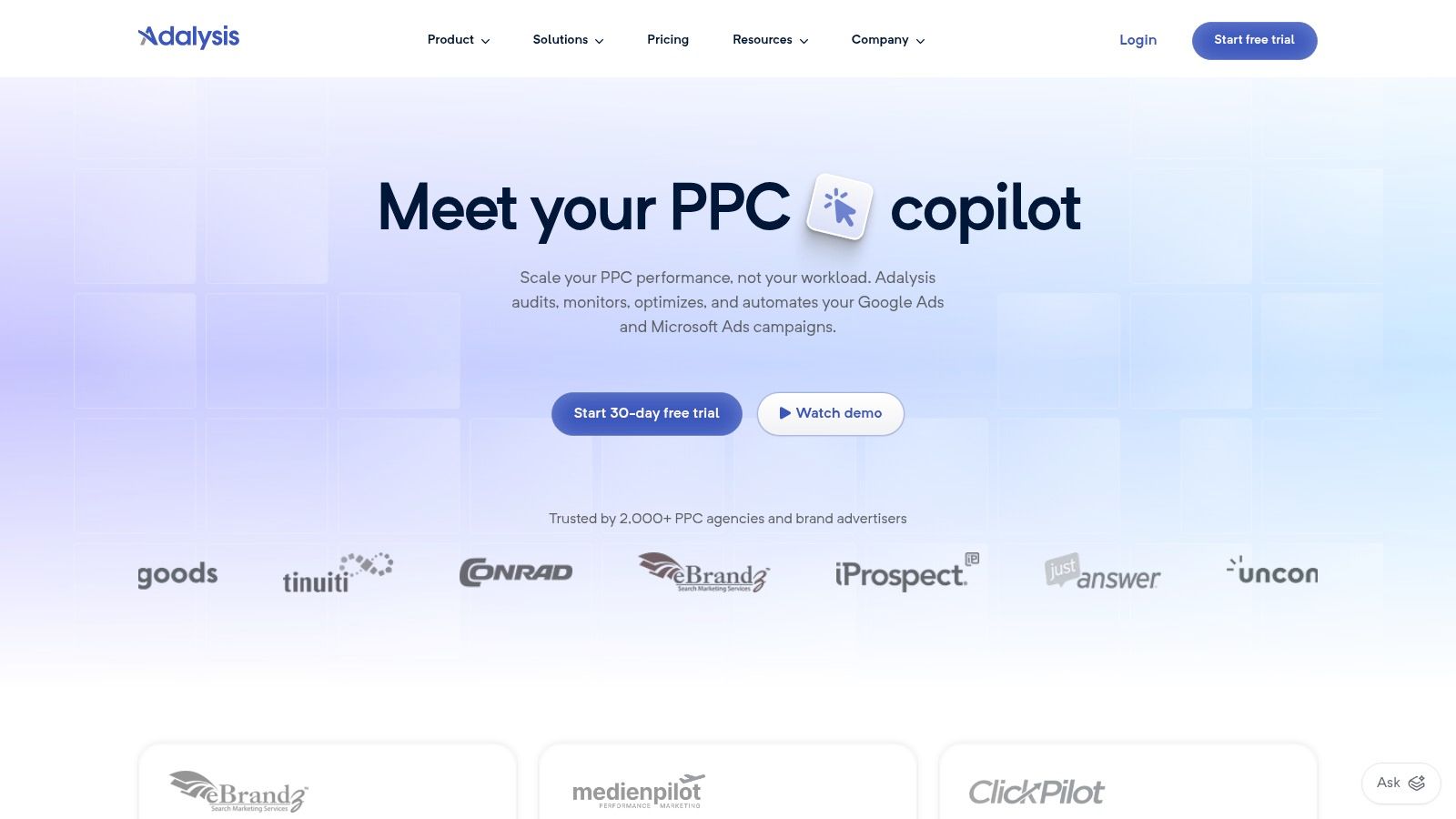
Adalysis takes a narrower position than Optmyzr. It’s primarily a Google Ads testing and account-hygiene platform, designed for teams that want disciplined ad experimentation and a reliable way to find technical issues before they become management tasks.
Its automated ad testing is the central reason to use it. The platform helps identify winning and losing ad variations, while issue monitoring surfaces broken URLs, negative keyword conflicts, and related account problems. Quality Score analysis adds a diagnostic layer, giving managers a prioritized view of potential fixes instead of forcing them to inspect every keyword manually.
That focus is a benefit for cost-conscious Google Ads teams. You’re not paying for a broad enterprise control surface if your immediate need is testing and hygiene. It also gives a PPC manager a clearer ongoing process: review the test queue, investigate account conflicts, apply corrective work, and preserve the winning patterns in future testing.
The limitation is equally clear. Adalysis isn’t the best choice if your main need is cross-channel budget movement, Meta execution, or a broader agency operating system. Its workflow is about improving the quality of Google Ads accounts, not coordinating every advertising network from one console.
Pricing is spend-based, which can be a sensible fit when the tool’s value tracks the Google Ads portfolio it supports. It can also make forecasting less straightforward for agencies with uneven client portfolios. Before adopting it, check how connected accounts are grouped and how pricing changes as client spend changes.
Use the Adalysis platform when ad testing and account hygiene are the primary operational problems. Choose a broader system if you need campaign construction, multi-network execution, or centralized governance.
4. Opteo
Opteo is designed for teams that want Google Ads recommendations without a heavy implementation project. Its action queue turns account analysis into a structured list of suggested improvements, with refresh cycles that help managers return to the same workflow instead of rebuilding an audit from scratch.
The interface is approachable, which matters for smaller agencies, newer PPC managers, and in-house marketers who understand performance goals but don’t want to maintain an elaborate rules framework. Reporting templates, lightweight pacing tools, and alerts cover the recurring communication layer without turning the product into a large enterprise system.
The trade-off is channel depth. Opteo is Google Ads only, so it won’t build or control Meta or TikTok campaigns. It also offers fewer advanced automations than a platform such as Optmyzr or Search Ads 360. That’s not necessarily a flaw. Smaller teams often need a clean decision queue more than they need a highly configurable automation engine.
Agency workflows benefit from client segregation and NDA-friendly handling, but the fit still depends on how much execution the team expects from the software. Opteo is best when a human reviews and applies recommendations. It’s less suitable when the desired workflow is an agent that can perform operational changes across a large portfolio.
The Opteo platform is worth evaluating if your team manages Google Ads, wants a low-friction interface, and values accessible recommendations over broad network coverage. If the portfolio includes multiple networks, treat Opteo as a specialist component rather than the entire PPC management stack.
5. Skai
Skai belongs in the enterprise governance category. It brings together paid search, paid social, and retail media for organizations that need coordinated planning, activation, measurement, and portfolio-level decision-making.
Its operational value is breadth combined with control. Teams can work with unified planning, forecasting, portfolio bidding, scenario planning, and GenAI-assisted workflows. Retail media coverage is particularly important for brands with complex product catalogs and marketplace programs, where Google and Meta are only part of the buying environment.
Skai’s governance model is a better match for large organizations than for a small performance team that wants faster campaign edits. Enterprise integrations, permissions, planning processes, and measurement requirements can justify the complexity when many stakeholders need a common operating layer. They can also slow onboarding and make everyday tasks feel heavier than they would in a channel-native tool.
Pricing is sales-quoted, and the contract structure should be evaluated alongside implementation support, integrations, and services. A platform with broad coverage may reduce tool fragmentation, but that doesn’t automatically make it cheaper or easier to operate. Ask what the contract includes, which networks have full activation, and which workflows require additional services.
Choose Skai when governance, retail media, forecasting, and multi-network coordination outweigh the need for a lightweight interface. It’s a poor fit if you only need Google Ads recommendations or a simple rule engine.
6. Search Ads 360
Search Ads 360 is Google’s enterprise answer to multi-engine search buying. Its operational role is not cross-channel social execution. It’s centralized search management across engines such as Google, Microsoft, and Yahoo Japan, with bulk management, inventory campaigns, automated bidding, and deep connections into the Google Marketing Platform.
That makes it valuable for organizations that need a consistent search workflow across multiple engines and want their buying activity to connect with Campaign Manager 360 and GA360. Teams already invested in the Google Marketing Platform can gain a more coherent governance and measurement environment than they would by stitching together unrelated point solutions.
The main advantage is enterprise control inside a search-centric stack. Bulk operations and inventory campaign workflows can reduce repetitive work across large structures, while API access is included under SA360 commercial terms rather than charged as a separate API fee. That detail matters to teams building internal processes around the platform.
The main risk is overbuying. Search Ads 360 is likely unnecessary for a smaller program concentrated on one engine. Pricing comes through Google Sales or partners, so buyers need to evaluate the commercial model before assuming the platform fits their operating budget.
Search Ads 360 is a search orchestration layer, not a universal answer for paid social operations.
Review Search Ads 360 when multi-engine buying and Google Marketing Platform governance are central requirements. Teams designing large account workflows can also review this practical guide to large account management processes.
7. MarinOne
MarinOne is a cross-channel platform for teams that want to consolidate paid search, paid social, and eCommerce or retail media workflows. Its value sits between reporting and optimization. Agencies can use unified views to manage client reporting, budget pacing, alerts, and social automation without forcing every account into a separate reporting process.
The broad channel coverage is the primary reason to consider it. A team with several media networks can bring performance data and budget workflows into one environment, then use the platform to coordinate recurring monitoring. That reduces tool switching, although it doesn’t remove the need to understand each network’s native limitations.
MarinOne’s agency fit comes from consolidation. It’s useful when account managers spend too much time assembling cross-client reports or checking pacing across separate interfaces. Social automation rules and alerts can also reduce routine monitoring, provided the team reviews thresholds and owns the escalation process.
Vendor stability deserves careful attention. Marin Software has gone through restructuring and bankruptcy processes, so buyers should assess the current roadmap, support model, product continuity, and contract protections rather than evaluating features in isolation. Pricing isn’t public and contracts may be complex, which increases the need for a detailed commercial review.
The MarinOne platform can suit organizations that need broad channel reporting and optimization workflows. It’s less attractive when a specialist tool solves the core problem with less vendor and implementation risk.
8. Smartly.io
Smartly.io is the strongest specialist here for creative-scale workflows. It combines creative production, dynamic creative optimization, product feeds, campaign automation, and media buying across Meta, TikTok, Pinterest, Snapchat, Reddit, and YouTube through DV360 or Google Ads.
The platform makes sense when creative volume is the bottleneck. Feed-based ads and cross-channel personalization let large teams produce and manage many asset variations without treating every creative and campaign combination as a manual project. The media layer then connects production workflows with buying and measurement, which helps creative and performance teams work from the same operational system.
That strength comes with a cost in complexity. Smartly.io is built for large, creative-heavy programs, not a small team that needs a few budget rules. Custom pricing means you’ll need a sales conversation, and the onboarding process can involve workflow design, feed configuration, permissions, and integrations. Teams should also verify how much support comes from the platform, its services ecosystem, or internal specialists.
Creative governance is a significant advantage. Brand teams can establish production processes while media teams manage platform execution, reducing the chance that scale produces inconsistent assets or untracked variations. But the product won’t solve a search-only optimization problem as efficiently as Optmyzr or Adalysis.
Read about Meta Ads automation when comparing operational execution approaches, then evaluate Smartly.io if dynamic creative and high-volume social buying are the main reasons your team needs a platform.
9. Madgicx
Madgicx is a Meta-first workflow tool that combines automation rules, creative performance insights, audience discovery, and AI-suggested actions. Its native control is centered on Meta, while connectors bring in reporting data from Google, TikTok, GA4, and Shopify.
That distinction matters. A cross-channel report can help a manager understand the portfolio, but it doesn’t mean the platform can build or manage campaigns natively on every connected network. Madgicx is therefore a strong choice for a team whose main execution workload sits in Meta and whose other channels mainly need consolidated visibility.
The Meta workflow is practical for eCommerce and performance teams. Budget and bid rules can handle recurring optimization logic, while the AI Marketer action feed surfaces daily decisions for review. Creative analytics and audience discovery help managers connect asset performance with targeting and budget choices instead of treating creative reporting as a separate discipline.
The limitation is not subtle. Google and TikTok are reporting connections rather than native build and management environments, so a genuinely multi-network execution team will still need other tools. Pricing and trial experiences have also received mixed user feedback in the supplied product assessment, so buyers should test the current plan, billing behavior, data connections, and cancellation terms directly.
Visit Madgicx when Meta is the center of your operation and creative intelligence matters. Don’t select it as the sole PPC management layer if your team needs consistent write execution across Google, TikTok, and Meta.
10. Birch
Birch, formerly Revealbot, is the rules-and-alerts choice for teams that want granular automation across many accounts. Its core workflow is explicit logic. A performance manager defines conditions, actions, schedules, and notifications, then lets the platform monitor and respond across supported channels.
That makes Birch different from an agent that interprets a natural-language request and carries out a bounded operational task. Rules are predictable when they’re designed correctly. They’re also easier to audit conceptually, because the team can inspect the condition that caused an action. The downside is maintenance. As account structures change, old rules can conflict, overlap, or become irrelevant.
Birch adds AI-assisted rule creation, Explorer insights, Slack and email alerts, and planning or creation add-ons such as Stage. Hub supports first-party signals workflows. These additions point toward a broader operating layer, but the practical value still depends on how carefully the team documents its automation and controls permissions.
Spend-tiered pricing can rise as budgets scale, and entry tiers may restrict automation. That pricing behavior is important for agencies with growing clients or many accounts. The rebrand from Revealbot also means buyers should check current documentation, redirects, product naming, and onboarding steps before rolling it into a client-facing process.
Choose Birch when your team already thinks in conditions and wants high-volume monitoring, alerts, and repeatable rules. If you want an agent to connect diagnosis with execution while preserving a permanent activity record, AdCrunch is the more direct fit.
Top 10 PPC Management Tools: Feature & Performance Comparison
| Product | ✨ Core / Unique features | Execution & integrations | ★ Quality | 👥 Target audience | 💰 Pricing / value |
|---|---|---|---|---|---|
| AdCrunch 🏆 | Agent connectors (Claude/ChatGPT/Cursor/Adgent); Campaign Plans; Skills & Brands; permanent Activity log | Meta write (creations paused; no hard‑deletes/bid/target edits); TikTok & Google read‑only; REST API | ★★★★ | Performance agencies, freelancers, multi‑brand & growth teams | 💰 Pro €99/mo flat (unlimited accounts/seats); Enterprise SSO/SLA; 7‑day trial |
| Optmyzr | Rule engine & prebuilt optimizations; budget pacing | Google & Microsoft Ads; cross‑account views | ★★★★ | Agencies focused on search scale | 💰 Subscription; per‑account/seat models |
| Adalysis | Automated ad A/B testing; bulk QA; issue monitoring | Google Ads–first; limited social reporting | ★★★ | Teams prioritizing disciplined ad testing & hygiene | 💰 Transparent, spend‑based pricing |
| Opteo | Action queue with prioritized recommendations; reporting templates | Google Ads only; multi‑account agency workflows | ★★★★ | Small teams & newer PPC managers | 💰 Competitive for Google‑only teams |
| Skai (Kenshoo) | Unified planning/activation; GenAI workflows; retail media depth | Omnichannel (search, social, retail); enterprise integrations | ★★★★★ | Enterprises with complex multi‑network programs | 💰 Enterprise quoted (sales) |
| Search Ads 360 (GMP) | Bulk multi‑engine buying; inventory campaigns; GMP native integration | Google, Microsoft, other engines; deep GMP stack ties | ★★★★★ | Large advertisers/agencies using Google Marketing Platform | 💰 Enterprise quoted (GMP commercial terms) |
| MarinOne | Unified reporting & optimization; pacing workflows; social automation | Search, social, retail; GMP integrations | ★★★★ | Agencies consolidating multi‑client reporting | 💰 Custom pricing; evaluate vendor stability |
| Smartly.io | Dynamic creative (DCO), feed‑based ads; cross‑platform creative automation | Meta, TikTok, Pinterest, Snapchat; DV360/Google via integrations | ★★★★★ | Large, creative‑heavy social programs | 💰 Enterprise quoted; high‑scale focus |
| Madgicx | Automated budget/bid rules; AI Marketer action feed; creative analytics | Meta‑first build/control; cross‑channel reporting connectors | ★★★★ | Meta‑focused teams seeking AI suggestions | 💰 Mid‑tier pricing; mixed trial feedback |
| Birch (Revealbot) | Granular automation & alerting; AI‑assisted rule creation; Stage/Hub add‑ons | Multi‑channel automation; Slack/Email alerts; planning add‑ons | ★★★★ | High‑volume automation & monitoring teams | 💰 Spend‑tiered pricing; scales with budget |
Choose the Workflow That Matches Your Scale
The best PPC management tools aren’t interchangeable. Start with the operational action you need to improve, not the vendor with the longest feature page.
Choose AdCrunch when your team needs agent-connected work across Meta, TikTok, and Google Ads, with actual write execution on Meta, permanent activity records, and flat organization pricing. It’s especially relevant for agencies, freelance media buyers, multi-brand in-house teams, and growth groups that need to reduce the lag between identifying a problem and making a controlled change. The trade-off is that TikTok and Google remain read-only for now, so native execution still matters on those networks.
Choose Optmyzr for mature Google Ads and Microsoft Advertising optimization, especially when your team values configurable rules, pacing, diagnostics, and agency workflows. Choose Adalysis when ad testing, Quality Score analysis, and account hygiene are more important than broad campaign automation. Opteo is the accessible option for Google Ads teams that want a clean action queue and reporting without a large setup burden.
For enterprise complexity, the decision becomes more specialized. Skai fits organizations coordinating search, social, and retail media with planning and governance requirements. Search Ads 360 fits multi-engine search buying inside the Google Marketing Platform. MarinOne can support broad channel reporting and optimization consolidation, but vendor stability and contract terms need careful review. Smartly.io is the strongest choice when dynamic creative, feeds, personalization, and high-volume social production drive the buying decision.
Use Madgicx for Meta-first workflows that combine creative intelligence, audience analysis, and automated actions, while recognizing that its Google and TikTok connections are primarily for reporting. Use Birch for granular rules, alerts, and high-volume monitoring where the team wants explicit automation logic rather than broad autonomous judgment.
Before signing, validate the details that product pages often blur:
- Write permissions: Confirm whether each network supports reporting, recommendations, edits, campaign creation, or full execution.
- Supported networks: Check the exact depth of Meta, TikTok, Google, Microsoft, retail media, and creative integrations you need.
- Onboarding effort: Ask what your team must configure, import, map, approve, and maintain before automation becomes useful.
- Contract structure: Compare flat organization pricing with per-seat, per-account, spend-tiered, and sales-quoted models.
- Audit requirements: Verify activity logs, approval controls, rollback options, permission scopes, and exportability.
- Human ownership: Decide which changes an agent or rule may execute automatically and which require human approval.
Market context supports taking this decision seriously. The pay-per-click software market was estimated at USD 21.57 billion in 2024 and is projected to reach USD 69.37 billion by 2035, with an 11.2% CAGR across the 2025 to 2035 forecast period, according to Market Research Future’s PPC software market analysis. At the same time, the State of PPC 2026 survey found that 62% of 1,306 surveyed practitioners don’t use paid PPC management tools, while concerns about accuracy and quality remain a barrier to autonomous AI agents. That gap is a reminder that adoption alone isn’t the goal. The tool has to fit the team’s risk tolerance and operating model.
Run a controlled pilot with representative accounts before committing. Use documented safeguards, start with limited permissions, review every automated change, and compare the tool against your current workflow. Feature counts won’t tell you whether the system closes the diagnosis-to-action loop safely. A real pilot will.
AdCrunch connects Meta, TikTok, and Google Ads to Claude, ChatGPT, Cursor, and its built-in Adgent, giving multi-account teams a way to query live performance and execute controlled Meta changes with a permanent activity log. Visit AdCrunch to test an agent-connected PPC operations workflow and see whether flat organization pricing fits your account portfolio.