
Meta Ads Automation: What to Automate and What to Keep
Practical guide to meta ads automation covering safe AI write actions, platform constraints, audit trails, and best practices
- meta ads automation
- advantage plus campaigns
- ai ad operations
- agency workflow automation
- campaign audit trail
You know the moment. A client asks why spend jumped overnight, your buyer says nothing changed, and Ads Manager shows a handful of “helpful” adjustments that nobody on the team typed by hand. That’s where Meta Ads automation stops being a neat feature and starts being an operations problem.
Meta has pushed that shift for years. In Q4 2024, the company said Advantage+ shopping campaigns had passed a $20 billion annual run-rate and were growing 70% year over year Bulk Creatives. By 2026, one industry summary said 61% of e-commerce advertisers on Meta were using Advantage+ Shopping Campaigns, up from 38% in early 2025, and those advertisers saw an average 17% reduction in cost per acquisition versus manual campaigns Facebook CAPI. The key question isn’t whether automation works. It’s whether your team can govern it when it does.
Table of Contents
- The Moment an AI Starts Touching Your Ad Accounts
- What Meta Ads Automation Means
- What You Can Safely Automate and What You Should Not
- Safety Constraints Any Automation Stack Should Enforce
- Audit Trails and Accountability When an Agent Is Acting
- Why Measurement Has to Change With Automation
- Native Rules, API Rules, and AI Agents Compared
- Habits That Keep Meta Ads Automation Safe at Scale
The Moment an AI Starts Touching Your Ad Accounts
A Tuesday afternoon in a small agency war room usually starts with routine work. A media buyer refreshes Ads Manager, expects to see a few tired ad sets, and instead finds that an AI agent already paused three of them, shifted budget into two stronger campaigns, and drafted a new CBO for review across a stack of client accounts. The machine moved faster than anyone in the room could have, which is exactly why everyone suddenly gets quiet.
That reaction is healthy. Speed is useful only if the team can explain every write action afterward, reconstruct the chain of events when spend spikes, and trust the system enough to let it act again tomorrow. Meta ads automation is no longer just a way to save clicks. It’s a governance layer that can touch real budget, real creative, and real client reporting.
Practical rule: If you can’t answer “who changed what, when, and why” in under a minute, the automation is already too loose for multi-account work.
Meta’s own direction makes that concern unavoidable. The Marketing API supports rules that can start and stop ads, adjust bids, and reallocate spend with scheduled or trigger-based logic Meta Marketing API. Recent coverage also shows Meta pushing more campaign types toward Advantage+ defaults and consolidating manual controls Hawky. In other words, the platform is already choosing more of the system for you.
The useful stance is simple. Treat automation as a delegated operator, not a background convenience. If the agent can act, it also needs boundaries, logs, and a rollback plan.
What Meta Ads Automation Means
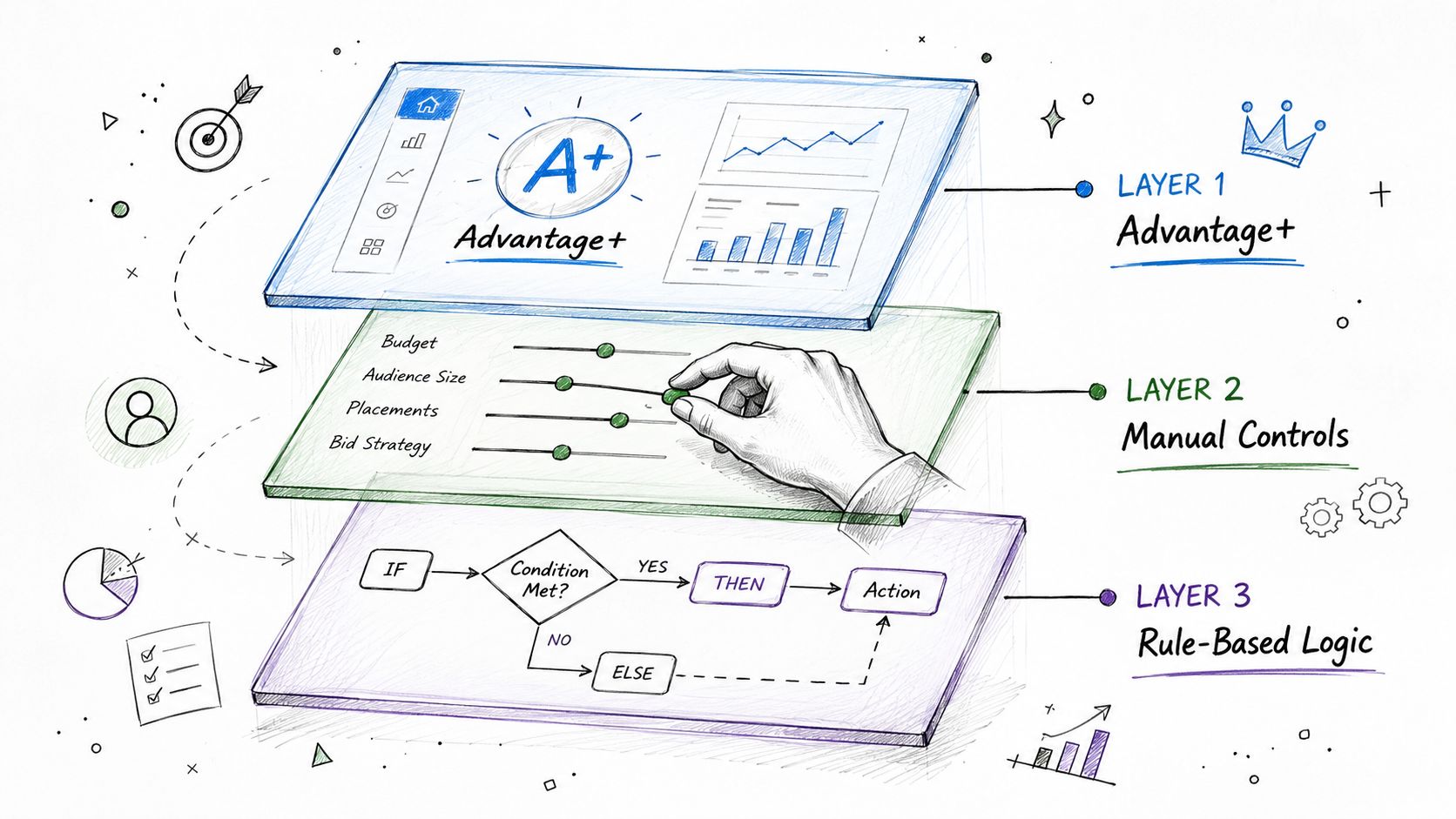
The defining question is what the agent cannot do, and what it can change without human review. Meta ads automation usually sits in three layers, and each one carries a different level of control and risk.
Native platform automation
Meta itself makes delivery decisions inside products like Advantage+ shopping campaigns. A DTC brand can hand over a product catalog, a conversion goal, and enough signal, then let Meta decide placements, audiences, and creative mix. Meta’s own testing for Advantage+ shopping reported 12% lower cost per purchase conversion versus business-as-usual ads across 15 tests Meta News.
Rules-based API automation
Your team writes the logic here. A common setup pauses an ad set after two consecutive days below a performance threshold, then sends a notification and logs the action. The value is predictability. The system follows the rule set, no more and no less.
AI-driven write actions
An AI agent can read account context, spot a pattern such as creative decay, and draft or execute a refresh through the API. That becomes useful when the account has enough structure that pattern recognition matters more than hand-built thresholds. Governance matters most at this layer, because the agent can interpret intent instead of only following fixed rules.
The practical split is straightforward. Native automation handles platform optimization, API rules handle explicit guardrails, and AI agents handle higher-level recommendations or writes when the account structure is mature enough to support them.
What You Can Safely Automate and What You Should Not
Some actions are low-risk because they’re repetitive, reversible, and easy to audit. Others are dangerous because they reset learning, distort attribution, or change the meaning of the campaign itself. The trick is not to automate everything. It’s to automate the parts where the consequence of a bad call is limited and the exit path is clear.
Automate the mechanical parts
Budget pacing, bid adjustments inside a tight range, scheduled dayparting, creative rotation under a clear fatigue threshold, and bulk pausing on hard stop-loss conditions are all sensible candidates. These actions are operational, not strategic. They keep waste down without redefining the account.
Keep humans on structural changes
Campaign objective changes, account structure edits, conversion event swaps, audience rebuilding, and any action that can exceed a defined spend cap should stay human-controlled. Those are the moves that can break the learning phase, shift what the platform optimizes toward, or make a month-over-month comparison meaningless. Recent reporting also notes that Meta’s automated systems are increasingly influencing delivery and budget allocation, while manual controls continue to shrink Media Performance. That makes structural discipline more important, not less.
Operational rule: If an action changes the meaning of the campaign, a person should approve it.
| Action | Safe to Automate? | Operational Risk |
|---|---|---|
| Increase or decrease budget within a preset band | Yes | Low, if the cap is tight |
| Pause an ad set after a stop-loss trigger | Yes | Low to moderate, depending on attribution lag |
| Rotate creative after fatigue rules fire | Yes | Moderate, if the signal is noisy |
| Change campaign objective | No | Can reset optimization behavior |
| Swap the conversion event | No | Can distort learning and reporting |
| Rebuild audiences | No | Can break continuity across tests |
| Exceed a defined spend cap | No | Budget drift and weak accountability |
If you want a practical planning format for rules your agent can execute, this campaign-planning approach is worth borrowing because it treats the plan and the write path as one controlled document.
The strongest teams separate repeatable execution from judgment-heavy changes. That boundary keeps automation useful without letting it rewrite the account’s strategy.
Safety Constraints Any Automation Stack Should Enforce
Good automation is less about what the agent can do and more about what it cannot do. The fastest way to keep control is to encode policy into the system, so the boundary is enforced by configuration instead of relying on someone to remember it at 4 p.m. on a busy day.
Set hard caps before you connect anything
Start with a maximum daily budget change, a ceiling on per-action spend, and a narrow allowed range for bid or budget movement. If the agent can only move a small amount at once, a bad call stays small. Tools like AdCrunch follow this philosophy, with creations starting paused, no hard-deletes, and no targeting changes to existing ad sets. That design serves as a blast-radius control.
Define scope by account and object
Spell out which campaigns, ad sets, and ad accounts the agent can touch. High-value accounts can stay behind human approval if the business cannot tolerate surprise changes. Scope matters more than teams expect, because a write that is safe in one brand can be reckless in another.
Limit write frequency and irreversible actions
A daily or weekly ceiling on edits keeps the system from thrashing. Cool-down windows between automated changes stop a rule from firing twice on the same signal. Permanent deletion should stay behind a human approval gate, or better yet, out of scope entirely. If the platform can pause or archive, that is usually enough.
Practical rule: A safe automation stack has a defined blast radius for every write.
The internal logic should read like code, not policy language. Write the constraint, test it, version it, and review it. That is the only way to deploy across dozens of accounts without creating a different risk profile every time a new client is added.
Audit Trails and Accountability When an Agent Is Acting
The accountability gap shows up fast in shared accounts. An account manager says the budgets didn’t move. A client says they never approved the change. The AI agent says it acted within bounds. Without a permanent activity log, everyone is guessing.
What the log has to capture
Every automated write should record the timestamp, the actor, the account and entity affected, the action taken, the before-and-after values, and a request ID that links back to the prompt or rule that caused the change. If that information isn’t stored together, the log becomes a trail of fragments instead of evidence. AdCrunch’s activity page is built around that idea, and the broader principle is the same whether the agent is human or machine.
Why request-origin metadata matters
The request origin tells you whether the change came from a scheduled rule, a human editor, or an AI agent. That matters when there are multiple editors in the same account and different people need different permissions. It also makes rollback possible, because you can tie a bad action back to the exact trigger instead of searching manually through account history.
The operational benefit is simple. When a budget jumps at 2 a.m., the log lets you answer the question immediately instead of opening a thread that lasts all morning. That also helps with reconciliation against reported spend, daily stakeholder diffs, and rollback decisions when an automated write needs to be reversed.
For larger teams, a process like the one described in this account-management workflow becomes much easier when every write is logged the same way. Accountability is a logging problem first. Permissions matter, but logs make permissions meaningful.
Why Measurement Has to Change With Automation
Automation pushes more decisions into the platform, which means signal quality becomes the limiting factor. If the platform is pacing budget, reallocating spend, and favoring some creative paths over others, noisy conversion data gets amplified instead of corrected. That’s why measurement discipline has to rise when automation gets stronger.
Make the event layer stricter
Pixel and Conversions API events need tighter governance once the system depends on them for optimization. Duplicate events, missing server-side signals, and inconsistent event naming make the model less trustworthy. If the inputs are fuzzy, the outputs will be too.
Compare platform truth with business truth
Automation can hide which specific decisions moved revenue, especially when results are aggregated at campaign level. That’s why weekly review should compare platform-reported CPA with advertiser-reported CPA, not just one of them in isolation. If the numbers diverge, the team needs to know why before more budget gets moved.
Test major changes before scaling them
Holdout tests and geo-lift tests are still useful when a platform is making more of the delivery decision. They don’t need to be fancy to be helpful. They just need to tell you whether a change improved the business, not only the dashboard.
Better signals let you trust more decisions, faster.
The measured posture here is blunt. Automation is only as good as the measurement system underneath it. Once Meta starts making more of the calls, the team’s job is to make those calls easier to verify.
Native Rules, API Rules, and AI Agents Compared
The best operating model depends on account count, team maturity, and how much unsupervised write access you can tolerate. A small brand with a few clean accounts doesn’t need the same stack as a multi-brand agency with shared editors, recurring launches, and frequent client approvals. The value is in matching the control model to the risk.
Where each model fits
Native Meta rules are cheap and fast to set up, which makes them good for simple threshold work. API rules are stronger when you need cross-account orchestration or more structured execution. AI agents become useful when pattern recognition spans creative, audience, and budget signals, and the team is ready to let the system propose or execute changes inside defined guardrails.
If you’re evaluating tooling around that stack, the comparison on ad ops tools is a useful companion because it separates management surfaces from actual write capability.
| Dimension | Native Rules | API Rules | AI Agent with Write Access |
|---|---|---|---|
| Setup cost per account | Low | Medium | Medium to high |
| Decision speed | Fast | Fast to very fast | Fast, sometimes proactive |
| Blast radius on bad calls | Limited if rules are narrow | Depends on scope design | Highest if guardrails are weak |
| Auditability | Basic | Good if logging is built in | Strong only if request metadata is captured |
| Best use case | Simple thresholds | Cross-account coordination | Pattern-based changes and assisted execution |
Native rules win when the trigger is obvious. API rules win when the same logic has to run across many accounts. AI agents win when the account has enough complexity that humans spend too much time spotting the same patterns repeatedly.
The wrong choice is letting the tech stack outrun the team’s ability to explain its own writes. That’s where automation stops being a force multiplier and starts becoming noise.
Habits That Keep Meta Ads Automation Safe at Scale
The teams that scale automation well aren’t the ones with the most tools. They’re the ones with the most boring habits. They start small, write things down, and make sure no one can accidentally do too much at once.

Start every new rule in observe-only mode for at least one learning cycle. Cap daily write volume per account so a noisy signal can’t trigger a cascade. Keep a human approver on destructive actions, even if the system can technically take them.
Habits that separate safe teams from risky ones
- Version-control rule logic: Keep the exact condition and action history so changes are reviewable later.
- Review weekly rollups: Don’t just look at performance, look at what the agent changed and why.
- Use narrow scopes first: Give a new automation rule a small blast radius before you let it touch more accounts.
- Treat rollback as standard: If you can’t reverse the write quickly, the rule isn’t ready.
The video below is a useful companion if you’re building a mental model for how these workflows stay controlled in practice.
Automation at scale is not about handing over control. It’s about deciding which control to centralize, which control to limit, and which control to never give away. Teams that get that right can move faster without losing the paper trail.
AdCrunch gives multi-account teams a way to connect Meta, TikTok, and Google Ads to agent workflows while keeping write actions and activity history in one place. If you’re trying to govern Meta ads automation without losing auditability, visit AdCrunch and see how its write-scope and logging model can fit into your process.