
Large Account Management Process for Ad Ops Teams
Master the large account management process for multi-account ad operations. Learn playbooks, audit trails, and automation checkpoints that scale.
- large account management process
- ad operations
- multi-account management
- ad account governance
- campaign automation
You can tell when a large account management process is healthy because the team stops asking, “Who owns this?” every time a budget shifts, a permission expires, or a client changes a naming rule. The work feels calm on the outside, but under the hood it’s usually held together by a few disciplined habits, plus a lot of cleanup when those habits break. In ad ops, the difference between a managed portfolio and a pile of live accounts is rarely strategy alone, it’s whether execution stays aligned day after day.
Most large-account frameworks talk about segmentation, goals, and quarterly review. Those pieces matter, and the classic cadence of a formal progress review every 90 days is still a useful anchor for enterprise sales and account management because it turns key accounts into a managed portfolio rather than an ad hoc relationship set (agency account management overview). But if you run media across Meta, Google, and TikTok, the core question is simpler: how do you keep dozens of campaigns, budgets, permissions, and approvals from drifting apart before that review ever happens?
Table of Contents
- Why Strategic Frameworks Fail at the Operational Layer
- Connecting Accounts and Building Context on Day One
- Encoding Client Rules as Reusable Playbooks
- Building Safety Constraints That Prevent Costly Mistakes
- Standardizing Taxonomy and Review Cadences Across Accounts
- Automating Governance and Audit Trails at Scale
Why Strategic Frameworks Fail at the Operational Layer
A large account management process breaks down fast when the plan looks solid on slides but the operating layer is loose. The team may agree on structure, ownership, and pacing, yet live accounts still drift when permissions change, naming rules slip, or new launches pile up before anyone cleans the mess.
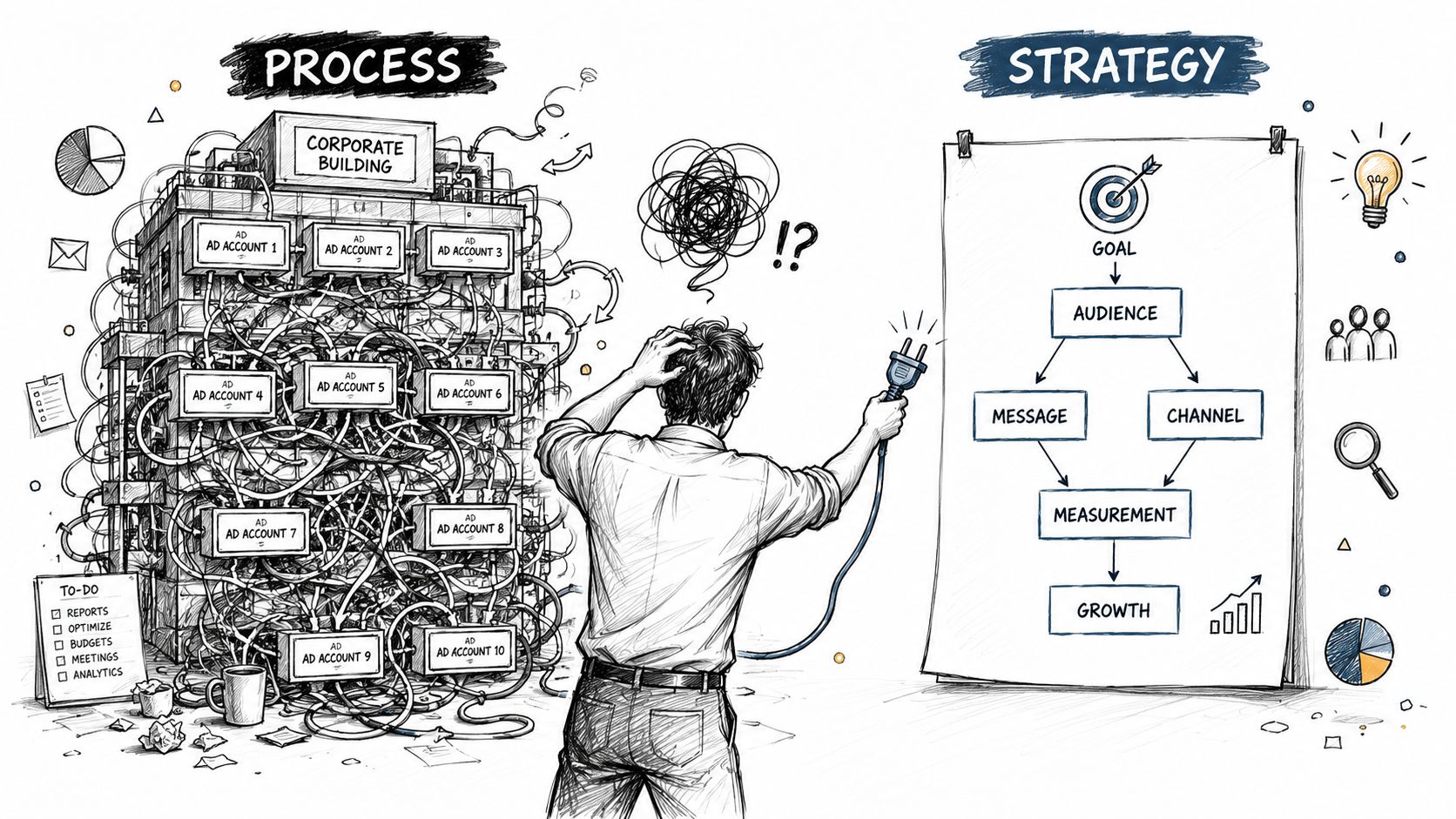
Permission drift breaks live work fast
Permission drift is usually the first operational failure. A contractor leaves, a client changes internal ownership, or a platform role shifts, and the person who needs access most is locked out while a campaign is already running.
Governance-heavy teams need an access record that shows who changed what, when, and on which object, with success or failure status attached to each event. That kind of audit trail guidance matters because it gives the team a defensible history when access questions surface later (audit trail guidance).
If a team can’t answer who touched the account, the team doesn’t really control the account.
Context loss is a hidden operational cost
Context loss is harder to spot, but just as disruptive. Account managers rotate, clients reorganize, and the next person inherits half a history in Slack, a few notes in a deck, and a naming convention nobody remembers defending.
A working large-account process has to preserve decision history, account structure, and the logic behind changes across the portfolio. Otherwise every handoff turns into detective work, and production pace slows while people reconstruct basic context.
Taxonomy decay ruins reporting
Taxonomy decay creates a different kind of failure. Once campaign naming, conversion mapping, and audience labels drift across accounts, reporting gets noisy and cross-account comparison stops being trustworthy.
A practical taxonomy and governance methodology keeps naming and KPI definitions consistent across accounts, then checks benchmark groups in rolling 30, 60, and 90-day windows normalized for spend and audience size (taxonomy and governance methodology). Without that discipline, larger accounts can look cleaner because they spend more.
Connecting Accounts and Building Context on Day One
Onboarding is where the large account management process either becomes usable or turns into another pile of logins. If access is messy, the first week gets spent chasing permissions instead of reading the account. If context lands cleanly on day one, the team can make decisions faster and with less guesswork.
Start with one controlled connection
I start by connecting the provider through an OAuth flow, because that removes password-sharing from the process and keeps credentials centralized. In the legacy setup, every client meant developer apps, token generation, and hand-offs that could stretch into days of back-and-forth before real work began. Google Ads API onboarding itself isn’t a single click, either, it requires creating OAuth credentials in Google Cloud Console, configuring the consent screen, then generating a refresh token after the client ID and secret are in place (Google Ads API onboarding flow).
Access should be a setup task, not a recurring project.
A practical detail matters here. Google’s developer token access process can face delays, with one report noting Basic Access targeting two business days and Standard Access typically taking up to 10 business days in February 2026 (developer token backlog report). In other words, onboarding friction is real, and planning around it beats pretending it won’t happen.
Pull context before the first live change
Once the connection is in place, the account needs historical context, not just a blank shell. AdCrunch’s onboarding flow, for example, pulls the advertiser list and backfills 90 days of insights automatically after connection, then lets you create a Brand, attach its advertisers, and add Personas so the client’s context follows every session. That same setup lets you encode the account’s rules as Skills, so naming conventions, budget caps, and approval steps are present before anyone touches a live campaign.
There’s also a practical time issue with configuration handoff. Salesforce notes that after changes in Installed Packages, it can take up to five minutes for newly generated access tokens to reflect those updates (Salesforce configuration propagation). Small delays like that become real friction when teams are trying to launch or reconnect across multiple accounts.
What ad ops means in practice is simple, the account has to be readable before it can be scalable. If the team can’t see the structure, the history, and the rules quickly, every later decision becomes slower than it should be.
Encoding Client Rules as Reusable Playbooks
Most account teams already have rules. The problem is that the rules live in people’s heads, scattered notes, or old Slack messages. That works until someone new joins, a launch gets rushed, or a client asks why a routine change was handled differently last time.
Turn tribal knowledge into a working system
Reusable playbooks should cover the situations that cause the most damage when they’re handled inconsistently. Budget reallocation, creative rotation, audience expansion, approval routing, and naming conventions are good starting points because they touch both performance and control. Once those rules are written down in a structured way, they stop depending on one person’s memory.
A playbook only helps if someone can use it without asking for translation.
Structured templates matter. The reusable ad ops playbooks approach is useful because it treats the process as something the agent or operator can read before acting, instead of something the team reconstructs every time. If a client requires daily pacing checks before a budget shift, that check belongs in the playbook itself, not in a buried comment thread.
Write the rule before the exception appears
The best playbooks don’t just describe what to do. They describe what must be true before action is allowed. If creative approval is required before launch, the approval condition sits in the playbook. If audience exclusions must be checked before expansion, that gate sits there too. That way, the workflow doesn’t depend on someone remembering the exception while they’re trying to move quickly.
Naming discipline matters as well. Standardized labels make the account intelligible across channels and help people avoid accidental duplication. It also keeps the playbook reusable, because a rule written around one account’s messy naming scheme won’t travel cleanly to the next client.
The practical test is simple. If a new hire can follow the playbook on their first task without creating a weird one-off interpretation, the rule is usable. If they need a ten-minute explanation before every step, the system still depends too much on human memory.
Building Safety Constraints That Prevent Costly Mistakes
Once an account is connected and the rules are written, the next job is protecting spend from bad mutations. That sounds abstract until someone pushes a budget change to the wrong line item, or a targeting update lands on an account that shouldn’t have accepted it in the first place. At scale, one mistake can infect multiple campaigns before anyone notices.
Use two layers, approval and validation
The cleanest control model is two-layer protection. First, the proposed change has to be approved. Second, the change has to be validated against client-specific constraints before anything hits the live environment. That’s the difference between a human signing off on intent and a system checking whether the request fits the account’s rules.
In practice, that means validating things like spend ceilings, frequency caps, audience exclusions, and launch conditions before the mutation is allowed through. AdCrunch follows a version of this model with approved Campaign Plans, line-item validation, and a mutation ledger that records what changed and when. That kind of structure matters because it catches budget and targeting errors before they reach the ad account, and it prevents an agent from pushing spend live without review.
Keep a mutation ledger, not just a memory
A mutation ledger should capture the proposed change, the validation result, and the approval chain that authorized it. That record gives you something stronger than a comment thread, it gives you durable accountability. When a client asks why a change happened, or when the team needs to unwind a mistake, the ledger becomes the source of truth.
The strongest control setups also make failure visible. If a rule references the wrong currency or a geo override would bypass brand safety filters, the system should flag the issue before creation, not after performance declines. The point isn’t to slow everything down, it’s to make unsafe actions fail early enough that nobody has to clean up a mess in a live account.
Good governance doesn’t block work, it blocks the wrong work.
Standardizing Taxonomy and Review Cadences Across Accounts
A team can lose control across multiple accounts fast when every client uses its own language. One account names campaigns one way, another maps conversions differently, and a third has a reporting hierarchy nobody can explain. After that, benchmarking turns into guesswork and optimization turns reactive.
| Operational Metric | Ad-Hoc Naming | Standardized Taxonomy |
|---|---|---|
| Cross-account comparison | Hard to trust | Easier to compare |
| New-hire ramp | Slow, account-specific | Faster, repeatable |
| Reporting cleanup | Frequent manual fixes | Less reconciliation |
| Benchmark grouping | Fragmented | Usable across similar accounts |
| Error detection | Outliers are hidden | Variance stands out sooner |
Standardization makes the data legible
A unified taxonomy layer should cover campaign naming, conversion event mapping, and audience segmentation labels. That helps reporting, and it helps the team and automation read each account the same way every time. Once the structure stays consistent, benchmark groups can be built by channel, tier, or segment and reviewed in rolling windows that fit the pace of the work.
Value becomes evident in the review cadence. Multi-account governance guidance points to rolling 30, 60, and 90-day windows normalized for spend and audience size, with variance reviewed alongside marketing, sales, and finance (benchmarking and taxonomy guidance). That gives the team a steadier operating rhythm than waiting for a monthly report to surface a problem that started weeks earlier.
Make reviews trigger action
A review should force a decision, not just produce a summary. If an account falls outside the baseline, the team needs to know whether to reallocate budget, refresh creative, or pause and re-test. That is the difference between a reporting cycle and an optimization loop.
Standardization also cuts down on scale confusion. Bigger accounts can look more efficient just because they spend more, so normalization matters if the team wants to compare like with like. Without that guardrail, the portfolio starts rewarding the accounts that are easiest to misread.
Automating Governance and Audit Trails at Scale
Governance turns messy fast when several people can touch live accounts. At that point, the job is not just to approve access, it is to keep every budget move, permission change, and campaign edit traceable enough that the team can defend it later.
Audit trails are operational infrastructure
An audit trail is part of day-to-day operations. It gives the team a record for checking odd campaign behavior, confirming who approved a change, and rebuilding the sequence of events after something goes wrong. It also helps when permissions drift, contractors leave, or someone still has access after the handoff.
If delegation is real, the log has to be real too.
Separation of duties matters for the same reason. The person who asks for a budget shift should not be the same person who signs it off when the account needs tighter control. That split lowers the chance of sloppy changes getting through and gives the team cleaner evidence when a client asks what happened.
Choose tools that preserve the record
The right ad ops tool should let teams review, approve, and act in one place instead of bouncing between dashboards, spreadsheets, and chat. If you are comparing options, ad ops tools that preserve audit history are the ones worth looking at first. AdCrunch fits that workflow, with OAuth connections to Meta, TikTok, and Google Ads, write access on Meta, and a permanent activity page that records the account, change details, request origin, and outcome.
That record matters most when something slips. A brand-safety issue without approval history can erode trust quickly. An intern deleting live ad sets can turn into hours of reconstruction if there is no durable log to inspect. Automated evidence collection shortens the gap between diagnosis and action, which is what account management at scale depends on.