
Best Media Buying Tools 2026: Pick the Right Platform
Discover the 7 best media buying tools for 2026. Compare platforms for cross-network execution, automation & governance to find the right fit for your agency.
- best media buying tools
- media buying platforms
- ad automation tools
- ppc management software
- agency ad tools
You’re staring at the same ugly gap every buyer knows. The report says a campaign is burning at a €62 CPA, the fix is obvious, and then the work starts, client sign-off, platform hopping, and a dozen logins before anything changes. That delay is where the best media buying tools separate themselves, because the useful ones don’t just show you the problem, they help you act on it.
The market is rewarding that shift to execution. In the U.S., programmatic advertising revenue reached $162.4 billion in 2025, up $27.6 billion year over year, a 20.5% increase from 2024, according to the IAB/PwC Internet Advertising Revenue Report. Digital spend is also carrying most of global ad investment, with one major forecast putting global ad spending at $1.17 trillion and digital investment rising 7.4% in 2025, according to eMarketer’s global ad spending forecast. That scale matters, because the right tool has to keep up with a market where reporting alone doesn’t cut it.
Table of Contents
- 1. AdCrunch
- 2. Smartly.io
- 3. Skai
- 4. Sprinklr Marketing
- 5. Madgicx
- 6. Revealbot
- 7. Optmyzr
- Top 7 Media Buying Tools, Feature Comparison
- How to Choose Your Media Buying Command Center
1. AdCrunch
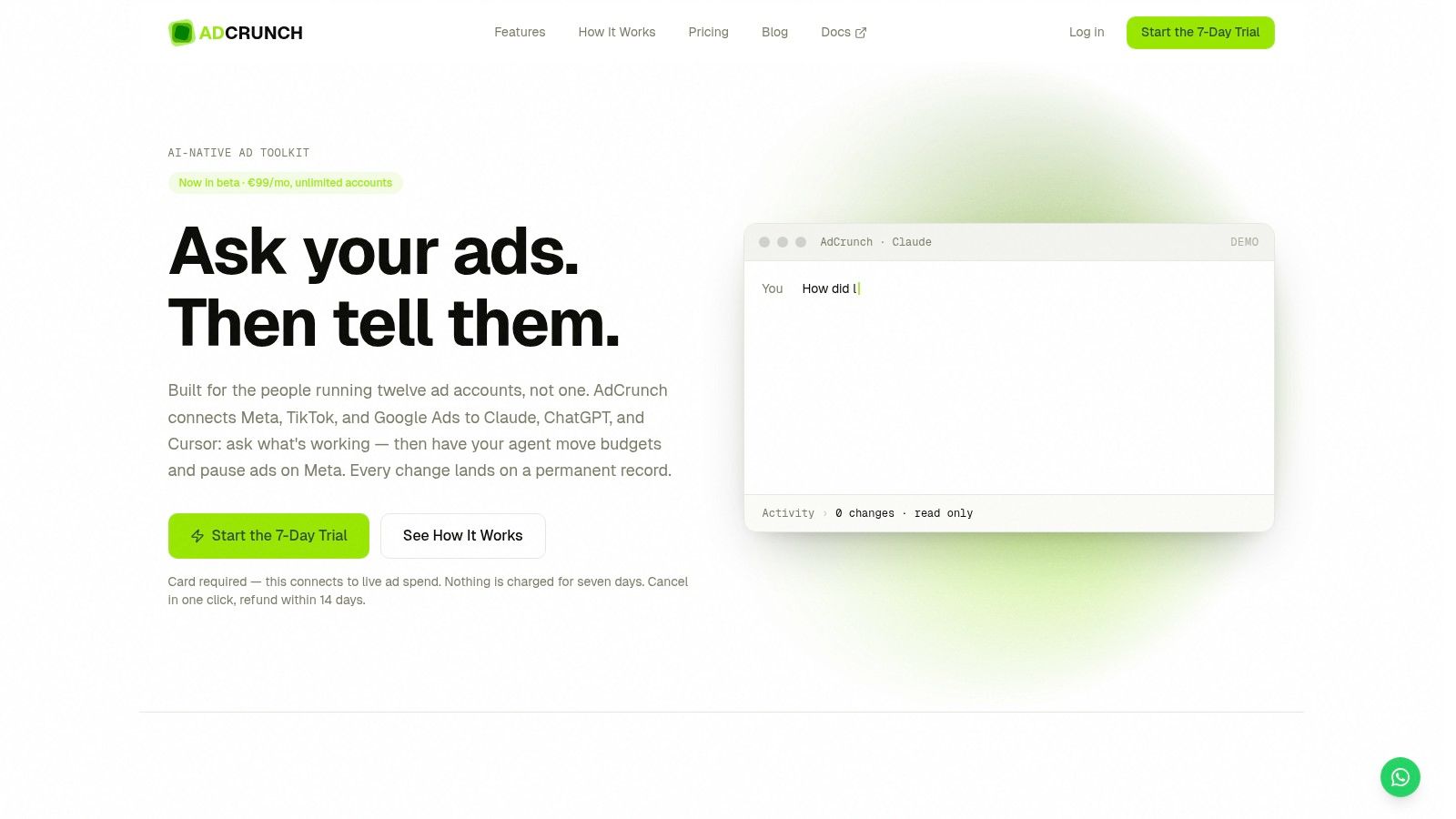
AdCrunch is the clearest answer if your problem is the action gap. It connects Meta, TikTok, and Google Ads to agents in Claude, ChatGPT, and Cursor, plus its own in-console agent, so you can ask what’s happening and then tell the system to move budgets or pause waste without leaving the workflow. Its primary value isn’t novelty, it’s that the platform is built for teams who spend their day inside multi-account operations and need one controlled place to diagnose, decide, and execute.
Why buyers like the control model
The strongest feature here is bounded write access with a permanent record. On Meta, the agent can build campaigns, ad sets, creatives, and ads, change daily or lifetime budgets, and pause, resume, or archive entities. It cannot hard-delete, change existing targeting, or touch a bid, and anything it creates starts paused, which is exactly what experienced buyers want when automation is allowed to touch spend.
Practical rule: if a tool can’t show who asked for the change, what changed, and how it ended, it’s not ready for multi-account media buying.
AdCrunch’s Activity log records the account, the exact change, who requested it, and the outcome, which gives you a permanent audit trail for client reporting and internal accountability. That lines up with the broader governance problem in AI buying, where setup complexity, data security worries, and low transparency keep showing up as friction points in adoption. The product also supports Skills and Brands, so playbooks and brand rules are part of the execution layer instead of living in a separate doc nobody opens.
AdCrunch is priced differently from the usual per-account stack. The Pro plan is €99/month, with unlimited ad accounts and seats, which makes it easier to instrument small clients without watching margin leak out through seat math. The company says TikTok and Google Ads are read-only for now, so this isn’t a full cross-network execution engine yet, but for agencies trying to collapse the time between diagnosis and action, it’s one of the sharpest models on the market. Visit AdCrunch for the product details and demo material.
2. Smartly.io
Smartly.io fits teams that live in high-volume creative production. If your buyers and designers are constantly shipping new variants across social and video, this platform is built to keep launches organized while still giving media teams the controls they need to pace, test, and measure across channels.
Its value is the combination of creative automation and paid media execution. Smartly.io supports feed-based launches, dynamic creative optimization, cross-channel creative intelligence, and native workflows for Meta, TikTok, and Google Ads. That matters when the bottleneck isn’t media strategy, it’s getting enough clean creative into market fast enough to matter.
Where Smartly.io earns its keep
Enterprise teams usually pick it for governance as much as speed. The platform is designed for very large programs that need tight coordination across many surfaces, and its Brand Pulse measurement gives teams a more unified read on reach and attention than a pile of disconnected dashboards.
If your workflow is creative-heavy, Smartly.io helps the campaign engine keep up with the production engine.
The trade-off is straightforward. Smartly.io is often a serious enterprise commitment, and that makes it stronger for larger programs than for smaller spends or teams with little creative variation. If your biggest pain is not creative volume but repetitive account operations, a tool like AdCrunch or rule-based automation is likely a better fit.
3. Skai
Skai works for teams that refuse to keep paid social, search, and retail media in separate boxes. It gives operators one place to plan, activate, and measure across those channels, which matters when ownership is split but the fundamental question remains the same, where should budget move next?
The platform’s single UI covers Facebook, Instagram, TikTok, Snap, Pinterest, and LinkedIn, plus search and retail media. That breadth matters for enterprise teams that need cross-channel reporting and incrementality work instead of isolated channel scorecards. The decisioning layer, including Celeste AI, is built for operators who need more than passive reporting.
The trade-off is clearer once you compare tool classes. As The Ad Library’s comparison of media buying software notes, the market is splitting into tools that report, tools that buy, and tools that also act on the account against a KPI. Skai sits closer to planning and measurement, which is why larger organizations tend to choose it.
Why it works, and where it gets heavy
Skai’s strength is governance and visibility across a wider revenue surface. That makes it useful when budget decisions depend on seeing multiple channels together, not just reading one platform in isolation.
The cost is complexity. Enterprise contracts and setup can be more than a smaller team needs, especially if the actual bottleneck is getting changes live inside Meta or Google fast enough.
Use Skai when coordination across channels is the problem, not just execution inside one account. If you need a more direct path from insight to action, the extra platform weight can slow the loop you are trying to shorten.
4. Sprinklr Marketing
Sprinklr Marketing fits teams where paid media sits inside a larger customer experience operation. Global organizations use it because ads, organic publishing, listening, moderation, and governance live in one system, which helps when several teams touch the same brand and compliance cannot be left in a side spreadsheet.
Its Ads module supports cross-channel social ad creation, bulk editing, reporting, and AI-assisted optimization. The platform also gives enterprise teams RBAC and compliance workflows, so approvals and audit trails stay part of the buying process. That matters when a key challenge is not only ad performance, but getting changes cleared, reviewed, and shipped without creating risk. For teams exploring how AI can fit into that loop, this overview of AI campaign management is a useful reference.
The governance-first choice
Sprinklr works best when media buying overlaps with approvals, moderation, and brand safety. It gives enterprise operators one place to keep paid and organic activity aligned while keeping oversight across teams and markets.
That makes it a stronger fit for organizations that need control over the handoff from insight to action. If a team can spot a weak ad but still has to route it through legal, regional, and brand checks, the extra structure saves time later even if it adds weight upfront.
For readers comparing tool classes, Sprinklr sits closer to governance than to execution speed. It can reduce chaos and keep complex teams synchronized, but it can feel heavy if the main goal is to push changes live as fast as possible.
Sprinklr’s broader CXM framing reinforces that trade-off. It is not a point solution for one task, it is a unified operating layer, which is why larger agencies and multinational brands keep using it. If your bottleneck is the day-to-day move from diagnosis to launch, judge whether that breadth helps close the action gap or slows it down.
5. Madgicx
Madgicx is built for Meta-first teams that still want a clean view across the rest of the stack. It combines automation, creative intelligence, and analytics, which makes it a practical pick when your buyers spend most of their time in Meta but still need a broad performance picture.
The product’s AI Marketer handles budgeting and optimization, while its creative insights and fatigue detection help teams spot when ad wear starts dragging results. It also has a One-Click Report that pulls in visibility from Meta, Google Ads, TikTok, GA4, Shopify, and Klaviyo, which is handy when stakeholders keep asking for one clean readout instead of five separate dashboards.
Meta-heavy teams usually choose Madgicx for optimization speed, not for broad cross-platform execution.
The main limitation is that Google Ads management is largely reporting-focused, so this is not a universal command center. It’s more useful when Meta is the core channel and everything else supports the decision-making around it.
Madgicx also speaks to the broader AI buying trend. Nearly 60% of U.S. ad buyers had used or planned to use AI-powered buying products in the referenced survey, while setup and maintenance complexity, data security concerns, and transparency worries kept adoption from feeling effortless. The EMARKETER survey cited in the research brief shows why teams want automation but still need guardrails.
6. Revealbot
Revealbot, now Bïrch, is the right call if your team trusts rules more than black-box automation. Agencies like it because it lets them encode if/then logic, monitor campaigns, and execute bulk actions across multiple ad platforms without surrendering control to an opaque system.
It supports Meta, Google Ads, TikTok, and Snapchat in a single automation layer, plus custom metrics, historical logs, Slack integrations, and reporting workflows. That makes it especially useful for agencies with playbooks they want to apply consistently across accounts.
Transparent automation beats clever automation for many teams
The strongest reason to buy Bïrch is clarity. You can see the rule, you can see the trigger, and you can see the result, which makes it easier to trust across many accounts and many operators.
That matters because the market keeps showing the same governance problem. Industry coverage cited in the brief says 62% of U.S. ad professionals worry about data security, 61% say they don’t sufficiently understand the technology, and 60% worry about lack of transparency in decision-making. Those are exactly the kinds of concerns transparent rules engines help reduce.
The trade-off is that Bïrch is still a rules platform, not a deep creative or autonomous AI product. If you want the system to think through messy operational steps, AdCrunch goes further. If you want explicit control and broad connector coverage, Bïrch stays compelling.
7. Optmyzr
Optmyzr fits search-led teams, especially when Google Ads takes most of the budget and day-to-day tuning work. It combines optimization tools, a rule engine, 24/7 automations, and budget pacing, so operators can keep accounts healthy without living inside every account all day.
The platform also extends into Microsoft Ads and Amazon Ads, with budget tracking for paid social and advanced search and PMax tuning capabilities. That broader reach helps multi-account search teams that still want a tighter focus than a full social-first suite.
Search teams need pacing, not just reports
Optmyzr’s real strength is operational depth. Search managers use it for budget monitors, automated reallocation, and rule-based oversight across many accounts. It also suits teams that want transparent controls instead of an AI layer making too many decisions at once.
That matters because reporting alone leaves an action gap. A tool can show pacing issues, query waste, or budget drift, but if it cannot push a fix, the team still has to move from analysis to execution somewhere else. Optmyzr closes that gap inside search, while staying narrower than the cross-network action layer many multi-channel buyers need. The comparison of Good Morning and Northbeam makes that read-only gap obvious.
For PPC-heavy teams, that trade-off is clear. If your day is mostly Google Ads, Optmyzr is one of the most practical tools in the category. If your problem is turning insight into action across Meta, Google, and TikTok, you will probably want to compare it with more execution-focused PPC automation tools.
Top 7 Media Buying Tools, Feature Comparison
| Platform | 🔄 Implementation complexity | ⚡ Resources & efficiency | ⭐ Expected outcomes | 📊 Ideal use cases | 💡 Key advantages |
|---|---|---|---|---|---|
| AdCrunch | Medium, connector setup across networks; beta features | Low–Medium, Pro €99/mo flat; efficient multi‑account ops; Meta write only today | ⭐⭐⭐, fast operational interventions; centralized audit trail | Multi‑account agencies, freelance media buyers, in‑house multi‑brand teams | Conversational workflow; server‑side execution (safer creds); flat pricing; activity log; playbook execution |
| Smartly.io | High, enterprise feeds, DCO and creative pipelines | High, quote‑based; needs creative ops and asset feeds; very scalable | ⭐⭐⭐, high throughput and predictive creative scoring | Large enterprises and agencies needing massive creative scale and governance | Feed‑based launches; DCO; cross‑channel creative intelligence; near‑real‑time measurement |
| Skai (formerly Kenshoo) | High, cross‑channel planning, decisioning and governance | High, enterprise pricing; requires broad data integrations | ⭐⭐⭐, holistic planning, incrementality and cross‑channel optimization | Enterprise teams wanting unified social, search and retail media | Mature governance; consolidated reporting; published benchmarks |
| Sprinklr Marketing (Ads) | High, full CXM integration, RBAC and moderation workflows | High, module‑based contracting; centralizes paid+organic+listening | ⭐⭐, strong governance & auditability; heavier for pure performance teams | Global organizations centralizing CX, paid and organic workflows | End‑to‑end CXM with enterprise controls; approvals and audit trails |
| Madgicx | Medium, Meta‑centric setup with AI features and connectors | Medium, spend‑tier pricing; efficient for Meta workflows | ⭐⭐⭐, effective for Meta automation, creative insights and LLM control | Meta‑heavy advertisers wanting AI‑assisted operations | Deep Meta workflow coverage; creative fatigue detection; ChatGPT/Claude connectors |
| Revealbot (Bïrch) | Medium, rules engine configuration and playbook encoding | Medium, pricing scales by spend; broad connector coverage | ⭐⭐, reliable, transparent automation; not autonomous bidding | Agencies encoding explicit playbooks; multi‑account automation teams | Granular rules; historical logs; cross‑platform automation and alerts |
| Optmyzr | Medium, search‑focused tools, rule engine and automations | Medium, transparent pricing; optimized for PPC portfolios | ⭐⭐⭐, strong Google Ads performance and portfolio pacing | Search‑led teams needing deep Google Ads and PMax tuning | Depth on Google Ads; budget pacing/reallocation; frequent updates |
How to Choose Your Media Buying Command Center
The right tool depends on where your team loses time. If you need enterprise governance and creative automation, Smartly.io and Skai are strong fits. If your buying style is rule-based and transparent, Bïrch is a good match. If your work is search-heavy, Optmyzr gives you depth where it counts.
AdCrunch takes a different path, and that’s why it stands out in this category. It doesn’t just report on campaigns, it lets teams query, decide, and act in one workflow, with bounded write access, a permanent activity log, and flat €99/month pricing that doesn’t punish growth in ad accounts. That combination is especially useful for agencies, freelance buyers, and in-house teams that live with the lag between diagnosis and action every day.
The question to ask is simple. Do you need better reporting, better automation, or direct execution? Reporting tools help you understand. Automation tools help you repeat. Execution tools help you fix the account before the next day’s spend goes out.
If your team is still bouncing between dashboards, inboxes, and platform tabs, AdCrunch is worth a close look. It’s built for buyers who want to move from insight to action without losing control of the account, and you can see how it works on AdCrunch.