
7 Best Ad Management Software Platforms
Compare the best ad management software for agencies and in-house teams, including pricing models, network coverage, automation, and trade-offs.
- best ad management software
- ad management platforms
- multi-network advertising
- ad automation software
- advertising tools

The widest channel list doesn’t automatically make a platform the best ad management software. A reporting dashboard, an execution layer, and an enterprise governance suite solve different problems, even when they display similar metrics. The useful question is what your team needs to control, and how safely it can control it.
This comparison weighs write access versus reporting, network coverage, operational depth, pricing structure, agency and in-house fit, and safeguards such as approvals, permissions, and audit trails. It moves from AI-assisted execution and creative production to omnichannel coordination, portfolio optimization, standardized workflows, and transparent rules. The result is a shortlist matched to account complexity, not a feature-count contest.
Table of Contents
- 1. AdCrunch
- 2. Smartly.io
- 3. Skai
- 4. Sprinklr Social Advertising
- 5. Adobe Advertising
- 6. MarinOne
- 7. Birch
- Top 7 Ad Management Software Comparison
- Choose by Operating Model, Not Feature Count
1. AdCrunch
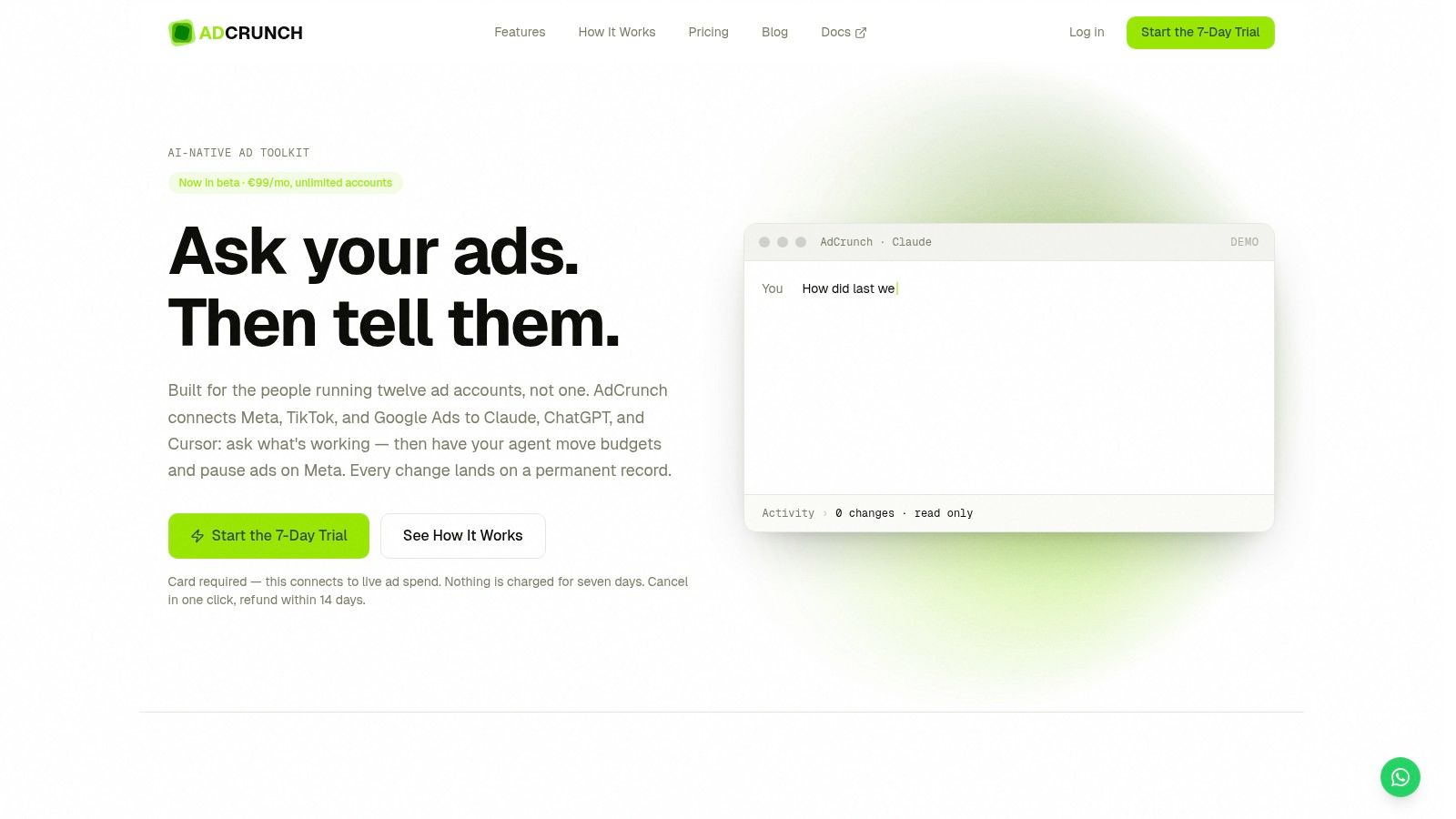
AdCrunch targets a specific operational gap: turning performance analysis into account changes within one workflow. It connects Meta, TikTok, and Google Ads with Claude, ChatGPT, Cursor, its in-console Adgent agent, and a REST API. Practitioners can query account data through a consistent connection, then assign execution work instead of stopping at reporting.
Its strongest job is AI-assisted execution for multi-account operators. Meta users can build campaigns, ad sets, creatives, and ads, change daily or lifetime budgets, and pause, resume, or archive entities. TikTok and Google Ads currently offer read-only access, so the platform is not yet a uniform write layer across networks. Teams managing several channels must account for that difference before standardizing operations around it.
Control is part of the product
AdCrunch places boundaries around write access. New creations start paused, hard deletes are unavailable, existing ad-set targeting cannot be edited, and bid changes are restricted. Credentials remain with AdCrunch rather than being exposed to connected language models. Each action is recorded in a permanent Activity log containing the request, account, change details, and outcome.
Skills & Brands let teams encode operating standards, while executable Campaign Plans connect planning with launch activity. That combination fits agencies standardizing delivery across clients, freelance media buyers managing multiple accounts, and in-house groups coordinating several brands or markets.
Practical rule: AI write access has value when teams can review changes, limit permitted actions, and verify the result afterward.
AdCrunch’s Pro plan costs €99 per month and includes unlimited ad accounts and seats. Enterprise adds SSO, an SLA, dedicated support, and custom integrations. A 7-day trial requires a card, and a 14-day refund policy applies. The flat organizational model can suit agencies and larger account portfolios, but a single-account advertiser may find its scope less relevant. See the AdCrunch AI ad operations toolkit to assess whether its Meta execution depth matches your workflow.
2. Smartly.io
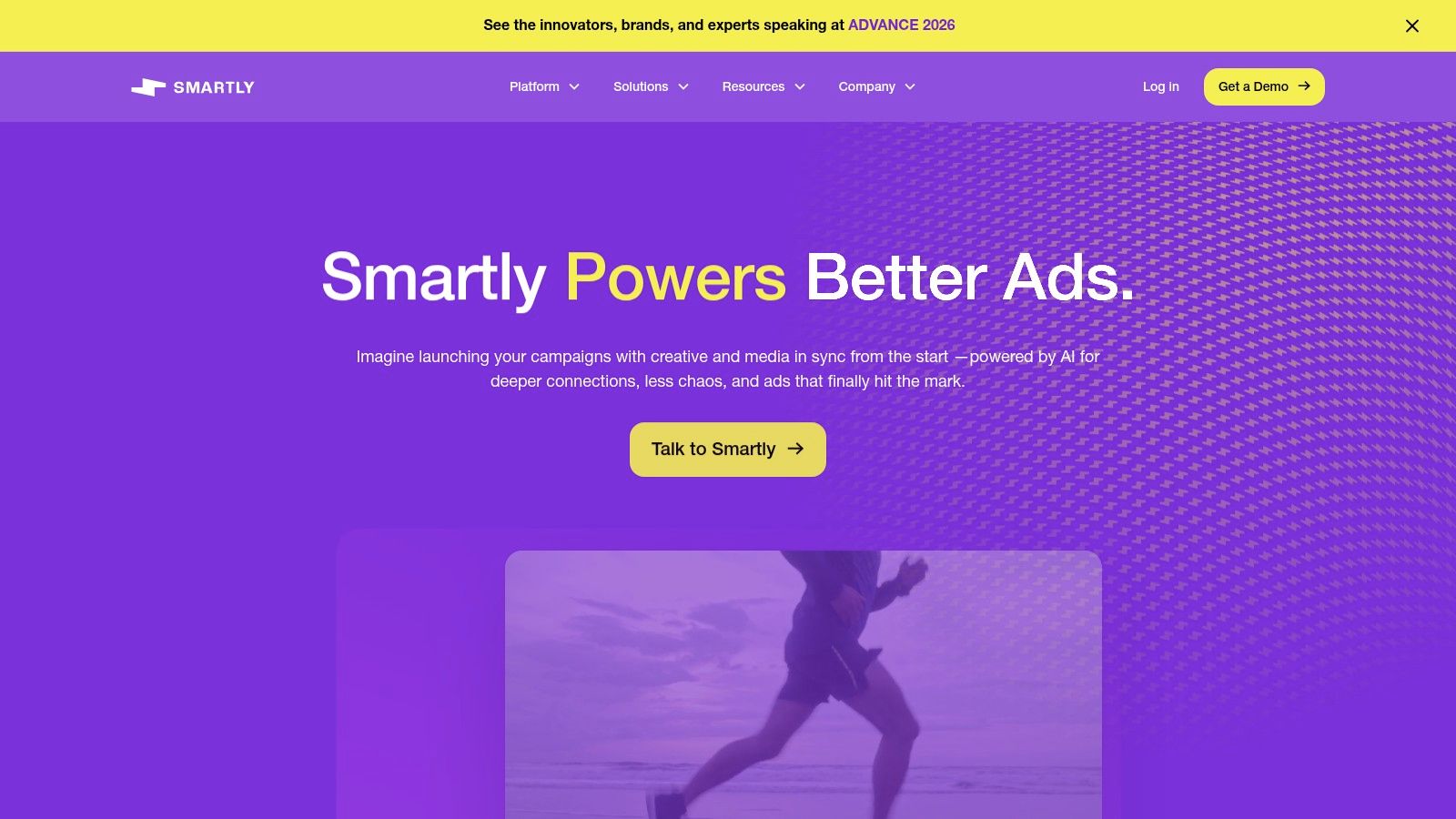
Smartly.io is strongest when the operational bottleneck is creative production at social scale. It combines campaign management with dynamic creative optimization, feed-based ads, templates, bulk workflows, collaboration, and centralized performance tracking. For brands and agencies running large Meta and TikTok programs, that combination can reduce the handoffs between creative teams, media buyers, and approvers.
The platform supports Meta, TikTok, Pinterest, Snapchat, Reddit, and YouTube, with Google support for selected use cases. That gives it broader coverage than a social-only console, although its value is clearest in paid-social programs where creative volume and market variation create the most work.
Best fit for creative-led operations
Smartly.io supports cross-platform campaign creation and automation triggers, including bulk workflows and rules. Its DCO and feed capabilities are particularly relevant when teams need to generate and test many creative variations while keeping production connected to activation. The trade-off is that this depth introduces enterprise-style complexity. Smaller teams may pay for production and governance capabilities they won’t use fully.
Pricing is quote-based and positioned for enterprise buyers. That makes direct cost comparison difficult, but it also signals the intended operating model. Smartly.io is less compelling as a lightweight tool for one advertiser and more compelling as a shared production and media system for sizable, multi-market programs.
For a broader view of how AI changes campaign operations, compare Smartly.io with AI campaign management workflows. The important distinction is execution scope. Smartly.io concentrates on creative-led campaign production and optimization, while AdCrunch emphasizes agent-directed operational changes and an auditable action trail.
3. Skai
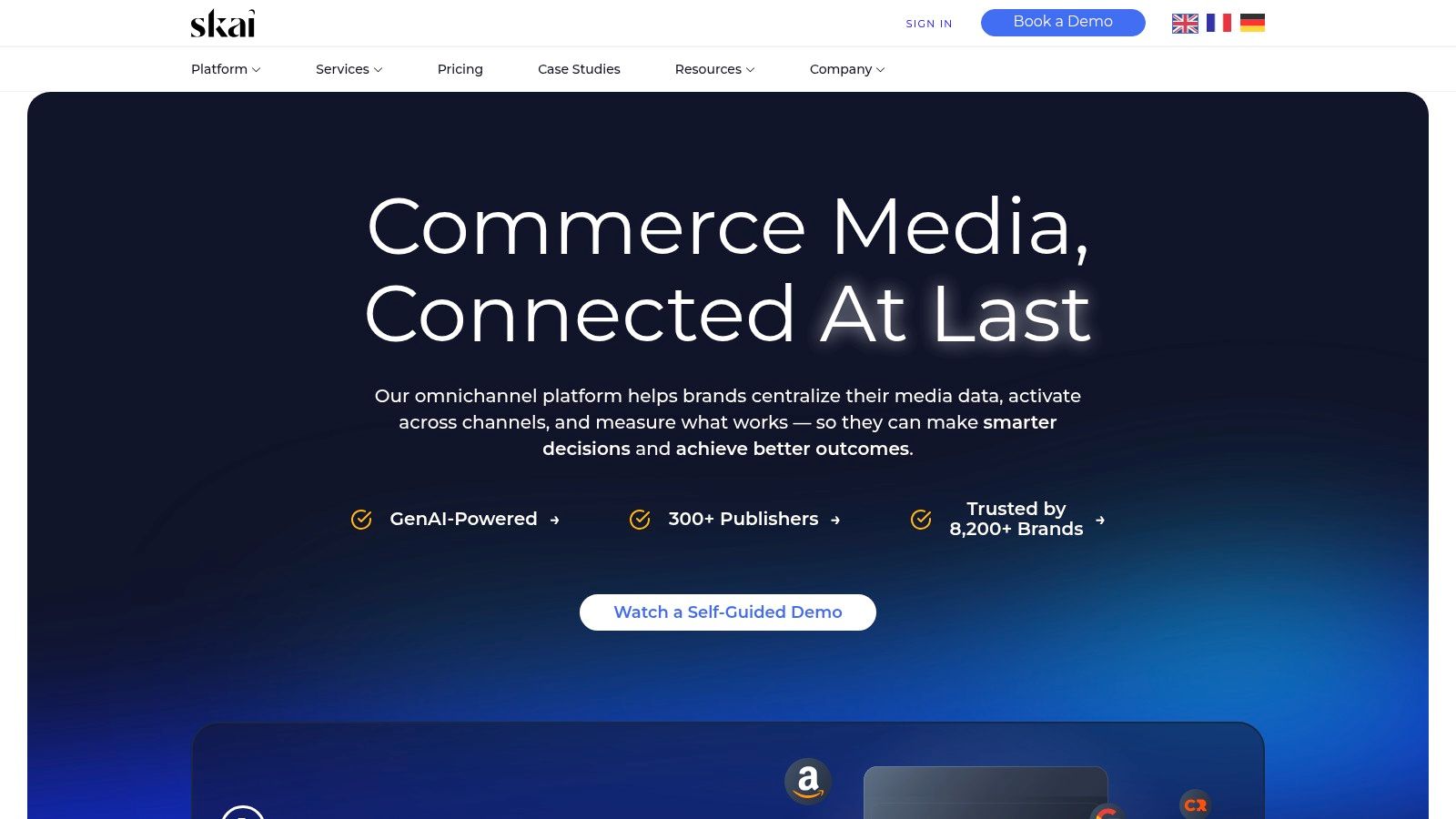
Skai is designed for organizations that need omnichannel portfolio coordination, not just paid-social management. It brings search, paid social, and retail media into one operating layer, with planning, forecasting, reporting, governance, and AI-assisted productivity. That makes it a stronger candidate for brands whose budget decisions cross Google, social publishers, and commerce media.
Its coverage includes Facebook and Instagram, TikTok, Pinterest, Snap, LinkedIn, and additional publishers, alongside search and retail media support. The strategic advantage is the unified view across different media environments. The limitation is that this breadth requires implementation discipline. A platform can centralize data without automatically resolving differences in attribution, conversion definitions, or business objectives between channels.
A portfolio layer for complex buying
Skai’s Celeste assistant is positioned around insights and productivity, while its planning and reporting capabilities help larger teams coordinate investment across walled gardens. Agencies can use that structure to create a common client view, but they’ll need clear conventions for naming, measurement, permissions, and optimization authority.
Pricing isn’t publicly listed and is custom or quote-based. Onboarding and implementation are also more substantial than the self-serve experience offered by a focused automation product. Skai therefore fits enterprise brands and agencies that need a strategic control layer across search, social, and retail media, rather than teams looking only for fast campaign edits.
The distinction is important for buyers comparing ad account management tools. Skai’s core advantage is breadth and portfolio governance. AdCrunch’s advantage is a simpler path from natural-language instruction to Meta write actions, with TikTok and Google Ads currently serving as read-only sources.
4. Sprinklr Social Advertising
Sprinklr Social Advertising suits organizations where governance and coordination matter as much as campaign speed. It supports paid-social planning, execution, optimization, bulk operations, automated workflows, and reporting across more than one social environment. Its distinctive value comes from placing paid, organic, and social-care activity within a broader enterprise workflow.
That structure helps large organizations create permission models, approval paths, and accountability across marketing, legal, brand, and regional teams. It also reduces the need to manage paid and organic work in disconnected systems. The cost is operational weight. A small performance team may find the suite harder to configure and administer than a focused campaign automation tool.
Governance before convenience
Sprinklr’s permissions and approval workflows are central to its fit. Enterprise advertisers often need to show who approved an asset, who changed a campaign, and which team owned the decision. Those requirements can outweigh the appeal of a faster but less controlled interface, especially when many departments share advertising access.
Pricing is typically premium and isn’t publicly listed. Buyers should therefore evaluate implementation effort alongside subscription cost. The question isn’t whether Sprinklr can manage campaigns. It’s whether the organization will use its cross-functional controls enough to justify the added complexity.
A platform that gives everyone access can create speed. A platform that gives the right people the right access creates accountable speed.
Sprinklr is a strong match for governance-heavy enterprises, regulated organizations, and teams coordinating paid and organic social activity. It’s less suitable for a freelancer or compact agency that mainly needs transparent rules, quick bulk edits, or a low-friction operating layer. For a more focused comparison, review the role of ad operations tools in reducing manual campaign work.
5. Adobe Advertising
Adobe Advertising, Search, Social and Commerce, is the natural choice for enterprises already organized around Adobe Experience Cloud. Its operating job is portfolio optimization across paid search, supported social, and commerce channels, with pacing, algorithmic bidding, advanced reporting, and connections to Adobe Analytics and audience data.
That ecosystem fit is its main advantage. Teams can align advertising decisions with the broader Adobe data and measurement environment instead of creating another isolated reporting layer. The platform is therefore less about lightweight campaign execution and more about managing investment across portfolios with enterprise reporting and optimization processes.
Strong portfolio depth, narrower social appeal
Adobe Advertising supports paid search and selected social and commerce channels. Its social coverage may lag behind platforms designed specifically for broad paid-social execution, so buyers should verify the exact publishers and actions required by their media plan. A team running a social-first operation across many networks may find Smartly.io or Sprinklr more directly aligned.
Pricing and onboarding are enterprise-oriented and quote-based. Adobe’s value increases when the organization already pays for, governs, and trains teams around Adobe products. Without that existing foundation, the implementation burden can make a more focused platform easier to adopt.
Adobe is a better fit for a large in-house marketing organization than for a freelance buyer managing a small collection of accounts. It can standardize portfolio decisions and reporting, but it isn’t positioned as a simple agent interface for immediate operational changes. Buyers should separate optimization intelligence from execution permissions before selecting it.
6. MarinOne
MarinOne provides a publisher-agnostic layer for teams that want to standardize reporting, bidding, and budget workflows across search, social, and ecommerce media. Its support includes Google, Microsoft, Meta, LinkedIn, Amazon, and other publishers, giving agencies and brands a way to work across accounts without treating each native interface as a separate operating system.
The platform’s Audience Hub supports cross-channel audience creation and management, while customizable dashboards bring performance views together. That makes MarinOne useful for agencies building repeatable reporting structures across clients, particularly when the agency wants an open layer rather than a suite tied to one media ecosystem.
Broad coverage with a traditional operating feel
MarinOne’s strength is breadth. It can help teams coordinate publisher activity and create a consistent workflow for bids, budgets, dashboards, and audiences. Its limitation is experience. Parts of the product have a legacy feel, and advanced customization may require support engagement, which can slow down teams looking for immediate self-serve changes.
Pricing generally comes through enterprise contracts rather than a simple public plan. That creates room for account-specific arrangements but makes cost forecasting less direct. Agencies should model the relationship between managed accounts, media volume, required customization, and support before committing.
MarinOne fits a mature agency or brand that values channel independence and centralized operations. It’s less attractive when the primary need is conversational AI execution, lightweight rule design, or a modern self-serve interface. It also deserves a measurement review, because centralizing reports doesn’t by itself reconcile differences between publisher-reported performance and outside-in business analysis.
7. Birch
Birch, formerly Revealbot, is the clearest choice for transparent rule-based automation. It supports Meta, Google Ads, TikTok, and Snapchat, with conditions, custom metrics, alerts, and integrations that can send information to tools such as Slack, Sheets, and attribution systems. Its appeal comes from showing teams the logic behind an automated action instead of hiding optimization inside a black box.
Performance teams can use Launcher and Explorer for bulk campaign builds and insights, while Stage adds structure to creative testing. That combination makes Birch useful for agencies and in-house growth teams that already understand their operating rules and want those rules to run consistently across publishers.
Precision without a full enterprise suite
Birch’s spend-based pricing is public, and a free trial is available. That transparency supports faster evaluation than quote-only platforms, although costs can rise as advertising budgets grow. The product is therefore easier to adopt than many enterprise suites, but it may become less economical for high-spend teams that would prefer a flat organizational model.
Its control model is explicit. Users define conditions, thresholds, alerts, and actions, then inspect what the automation is designed to do. That can be preferable to AI-led recommendations when the team needs predictable behavior and easy explanation. The trade-off is that rule maintenance remains part of the operating job. Someone must decide which conditions remain valid as campaigns, tracking, and business goals change.
Choose rules when explainability is the priority, and choose agentic execution when reducing the distance between diagnosis and action matters more.
Birch is less suited to organizations seeking integrated enterprise permissions, broad cross-functional workflows, or a unified paid and organic suite. It’s a strong fit for agencies and performance marketers who want granular automation with a clear mental model.
Top 7 Ad Management Software Comparison
| Product | Implementation complexity 🔄 | Resource requirements ⚡ | Expected outcomes 📊⭐ | Ideal use cases 💡 | Key advantages ⭐ |
|---|---|---|---|---|---|
| AdCrunch | Moderate, quick setup for multi-account; beta features | Low–Medium cost: Pro €99/org flat; minimal infra; card required for trial | 📊 Reduced wasted spend; faster ops; auditable activity; limited cross-network write today, ⭐⭐⭐⭐ | Agencies, multi-brand teams, multi-account media buyers | Automated execution, flat pricing, safety-first audit trail, unified agent |
| Smartly.io | High, enterprise onboarding and integration | High: enterprise/quote pricing; requires significant creative production resources | 📊 Scaled creative production & automation, robust multi-market optimization, ⭐⭐⭐⭐⭐ | Large organizations running sizable Meta/TikTok programs at scale | Mature DCO, creative automation, broad channel coverage |
| Skai (Kenshoo) | High, implementation effort for cross-channel consolidation | High: enterprise contracts; data integration and governance needs | 📊 Unified planning/reporting, forecasting and AI-assisted optimization, ⭐⭐⭐⭐ | Brands/agencies consolidating search, social and retail media | True multi-walled-garden coverage; enterprise governance/workflows |
| Sprinklr Social Advertising | High, complex enterprise suite with governance | High: premium pricing; requires cross-functional coordination | 📊 Strong compliance, unified paid+organic workflows, automated reporting, ⭐⭐⭐⭐ | Complex organizations needing approvals, permissions and unified ops | Robust compliance/permissions; consolidates paid and organic workflows |
| Adobe Advertising | High, integrates with Adobe Experience Cloud | High: enterprise-oriented pricing; best if on Adobe stack | 📊 Portfolio optimization, advanced pacing and reporting, ⭐⭐⭐⭐ | Enterprises standardized on Adobe tools managing search/social/commerce | Portfolio optimization, deep Adobe Analytics/audience integration |
| MarinOne (Marin Software) | Moderate, SaaS onboarding with customizable dashboards | Medium: enterprise contracts possible; publisher-agnostic integrations | 📊 Standardized reporting, bid/budget workflows, cross-channel views, ⭐⭐⭐ | Agencies/brands wanting an open, publisher-agnostic layer | Broad publisher support, Audience Hub, customizable dashboards |
| Birch (formerly Revealbot) | Low–Medium, self-serve rule setup; fast adoption | Low–Medium: spend-tiered pricing; clear public plans and trial | 📊 Precise, transparent rule-based automation and alerts, ⭐⭐⭐ | Performance teams preferring granular, transparent automation | Transparent rules, bulk builds, creative testing stages, clear pricing |
Choose by Operating Model, Not Feature Count
The right choice depends on the work your team wants the software to perform. If you manage many accounts and want an AI-assisted path from analysis to operational changes, AdCrunch is the strongest fit, especially when flat organizational pricing and a permanent activity log matter. Its write access is currently limited to Meta, so confirm that read-only TikTok and Google Ads coverage matches your process.
Choose Smartly.io when creative production, dynamic creative, and scaled paid-social execution are the center of the operation. Choose Skai when search, social, and retail media need to sit within one enterprise planning and governance layer. MarinOne serves a similar coordination need with a publisher-agnostic approach, particularly for agencies standardizing reporting and bid or budget workflows.
Sprinklr makes more sense when permissions, approvals, auditability, and paid-organic coordination are essential across a large organization. Adobe Advertising is the logical option for enterprises already invested in Adobe Experience Cloud and looking for portfolio optimization, pacing, bidding, and reporting connected to that ecosystem. Birch is the better choice when performance teams want transparent conditions and granular rules rather than an opaque optimization system.
Before signing, test the actual operating path. Verify network permissions, available write actions, account limits, pricing behavior as your portfolio grows, approval requirements, audit-log detail, and whether the product executes changes or only reports them. Also examine measurement carefully. Platform-reported ROAS, incrementality, MMM, and first-party data answer different questions, so the best platform is the one that fits the decisions your team must make, not the one with the longest feature page.
The global ad management software market has been estimated at USD 35.58 billion in 2025 and projected to reach USD 88.08 billion by 2034, while another estimate values advertising software at USD 24.06 billion in 2024 and projects USD 46.1 billion by 2035, as reported by Fortune Business Insights’ ad management software market analysis. Those estimates point to a category moving toward more software-driven buying, optimization, and reporting. Your selection process should therefore focus on control, accountability, and measurable operating fit.
AdCrunch gives multi-account teams one AI-native workflow for reading Meta, TikTok, and Google Ads data, then taking controlled write actions on Meta with paused-by-default creations and a permanent activity log. Visit AdCrunch to explore the €99-per-month flat Pro plan and test whether faster, safer ad operations fit your agency or in-house team.