
AI Marketing Automation: From Rules to Agents
Learn how AI marketing automation moves beyond scheduled triggers to agent-driven execution, with workflows, governance, and trust guardrails explained.
- ai marketing automation
- ad operations
- marketing workflows
- automation governance
- media buying
The most popular advice about AI marketing automation is also the least useful: connect your tools, generate more content, and let the system optimize campaigns while your team watches the dashboard. That describes production assistance and rule-based automation, not delegated ad operations.
The frontier is narrower and more consequential. An agent must read live account structure and performance, interpret a business question, choose from a limited set of actions, and leave a permanent record of what it changed. On live client spend, the important question isn’t what the model can generate. It’s what the system is allowed to write.
Table of Contents
- What AI Marketing Automation Actually Means Now
- From Database Triggers to Agentic Execution
- The Bounded Verb Set That Defines Agentic Ad Ops
- A Mid-Week Spend Triage in One Question
- Why Trust Is the Binding Constraint
- Where AI Creates Real Leverage in Media Buying
- When You Should Avoid Full Automation
- Choosing a Vendor Worthy of Live Spend
What AI Marketing Automation Actually Means Now
Most software sold as marketing automation still works like this: you define a condition, select an action, and let the platform repeat the instruction. Meta’s automated rules, for example, let an advertiser define conditions in advance and choose an action such as pausing a campaign or ad set when the condition is met, including a displayed example where CPA exceeds $50, with the rule applied at campaign, ad set, or ad level (Meta automated rules explained).
That system is useful. It isn’t the same as an agent interpreting a goal. A scheduled report summarizes performance. A trigger reacts to an event. A lookalike audience produces a targeting output. None of those necessarily closes the gap between seeing a problem and changing live delivery.
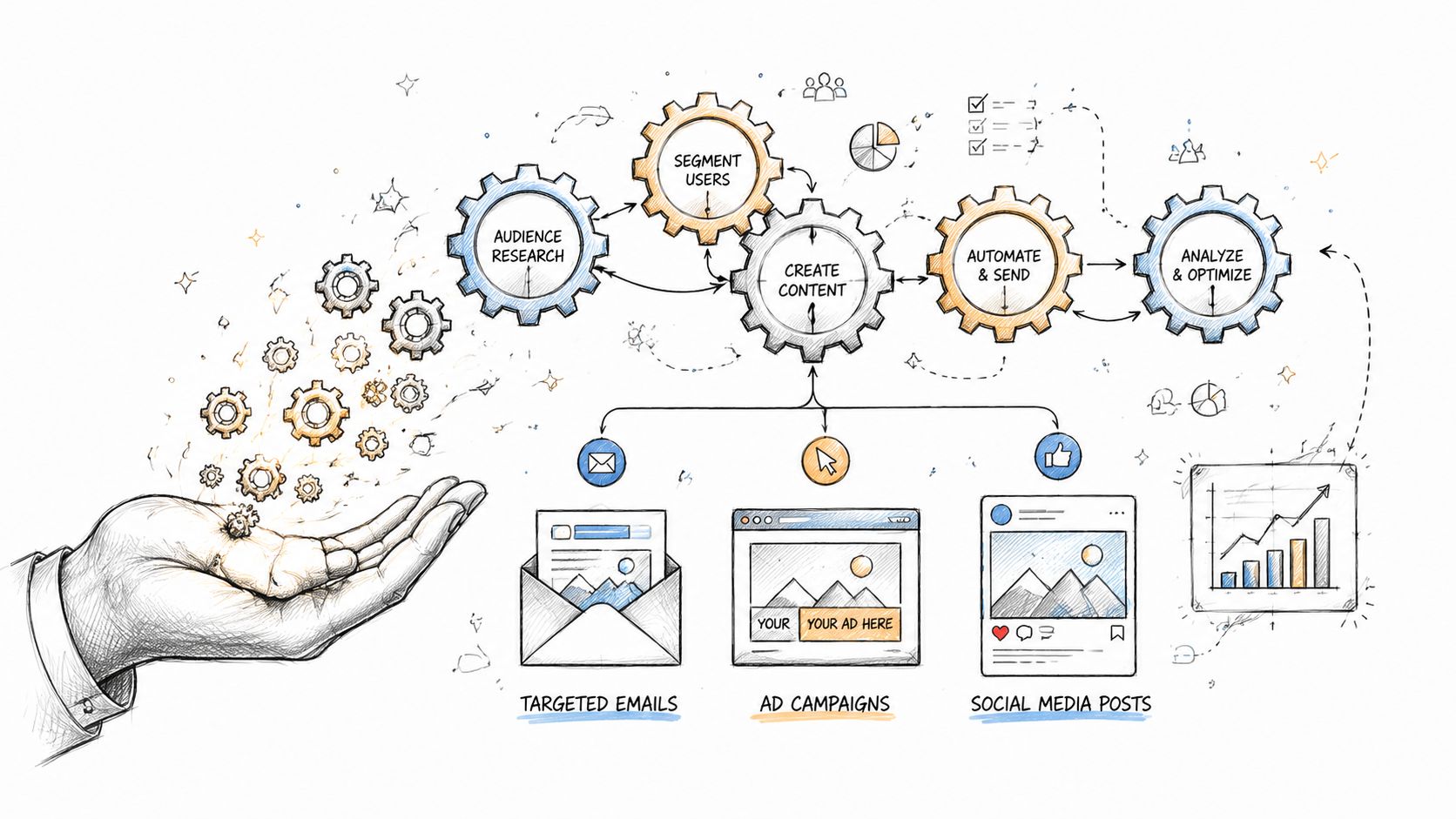
Three tests for real execution
Ask these questions before accepting a vendor’s definition:
- Did the system observe? Can it inspect current account structure, spend, results, and relevant exclusions across connected platforms?
- Did it decide? Did it interpret a goal such as protecting efficiency, rather than merely match a pre-written threshold?
- Did it act? Did an approved action land on the advertising account, or did the system only produce a recommendation?
The terms matter because vendors often place different capabilities under one label.
- Triggers are passive events. They notify or start something after a condition occurs.
- Rules are pre-written instructions. They follow explicit if-then logic.
- Workflows chain several steps, such as fetching data, filtering entities, requesting approval, and recording an outcome.
- Agents pursue a goal through interpretation and action, but only within a defined permission boundary.
A safe agent doesn’t receive unlimited authority. It receives a published verb set, clear ceilings, and a review path. New campaigns, ad sets, creatives, and ads should arrive paused. Hard deletes, targeting rewrites, and unrestricted bid changes should be outside the write surface.
Practical rule: If a tool can explain the issue but can’t safely carry an approved correction to the account, it’s an insight tool, not delegated ad operations.
That distinction protects teams from buying a more expensive dashboard and calling it transformation. In this guide, execution rights, not generation capability, define the useful edge of AI marketing automation.
From Database Triggers to Agentic Execution
Marketing automation didn’t begin with large language models. Its roots are commonly traced to database marketing and early CRM systems in the late 1980s and early 1990s, followed by dedicated platforms such as Unica in 1992 and Eloqua, often described as one of the first real marketing automation platforms, in 1999 (history of marketing automation).
The progression is easier to understand as a sequence of narrower gaps.
Step 1, database selection
Early teams used customer records to select audiences for direct outreach. The system could retrieve contacts that matched known fields, but a human still decided the offer, prepared the execution, and reviewed the outcome.
Step 2, CRM-triggered messaging
Platforms including Eloqua, ExactTarget, and Responsys moved execution closer to the customer event. A contact action could start a follow-up, nurture sequence, or handoff. The system automated the known path, not the interpretation of an unfamiliar situation.
Step 3, marketing clouds and orchestration
The rise of marketing clouds such as Salesforce and HubSpot connected CRM, content, email, and reporting functions. Cross-channel tools including Adobe Campaign, Braver, and Iterable made it easier to coordinate journeys across several touchpoints. The cloud automated the handoff between systems, while operators still diagnosed performance and chose corrective actions.
Step 4, platform-native ad rules
Google Ads and Meta Ads Manager brought automation directly into media buying. Automated rules, Target CPA strategies, and later Advantage+ capabilities reduced repetitive campaign management. These systems could optimize within their configured objectives, but their authority remained bounded by the platform feature and the advertiser’s setup.
Step 5, agentic interpretation
The newer agent layer can read dashboards, inspect structures, draft creative variants, and call platform APIs. The change isn’t better copy generation. The agent can interpret a natural-language request, gather the relevant evidence, stage an action, and ask for approval before writing.
A campaign plan can make that transition concrete. Instead of treating planning and launch as separate documents, teams can use a structured campaign plan an agent can execute so approved line items remain connected to implementation.
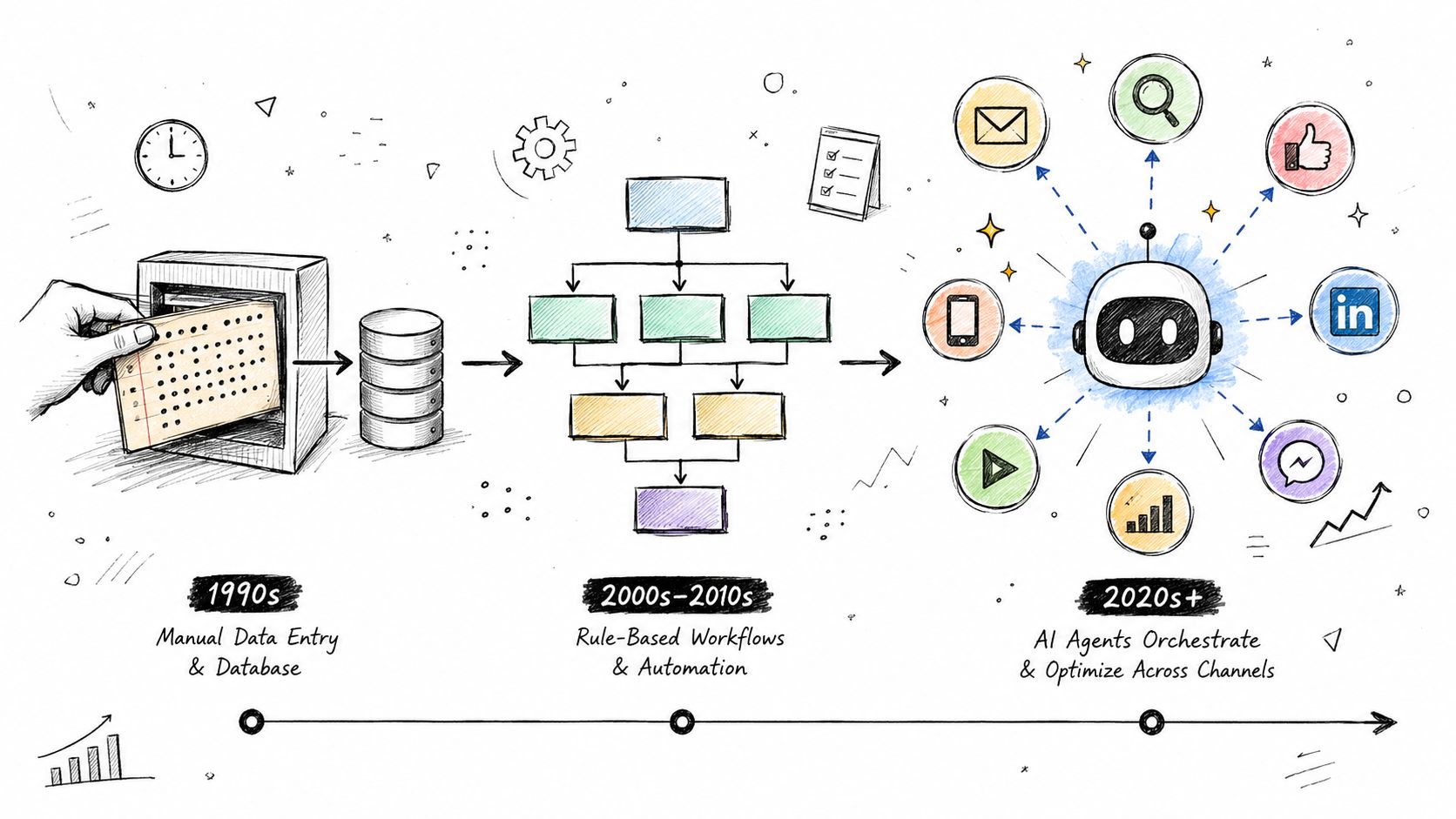
The historical pattern is consistent. Rules automated the obvious. Clouds automated coordination. Agents attempt to automate diagnosis. The risk rises at each step because the system moves closer to decisions that affect live spend.
The right design therefore isn’t “let the agent do everything.” It’s to narrow the distance between insight and action while keeping the action reversible, attributable, and reviewable.
The Bounded Verb Set That Defines Agentic Ad Ops
An agent operating on Meta shouldn’t receive a vague instruction such as “manage the account.” It should receive a small, published vocabulary. A practical set contains eight verbs:
pause_ad, to stop delivery for a specific ad.enable_ad, to resume an ad after review.adjust_budget, to change a permitted daily or lifetime budget.adjust_bid, to modify a bid only where the system explicitly permits it.update_status, to change an entity’s operational status.append_label, to add a label without rewriting the underlying structure.read_insights, to retrieve performance and delivery data.draft_creative, to prepare creative work without automatically sending it live.
These verbs don’t mean unlimited control. They exclude hard deletion, targeting changes to existing ad sets, and unreviewed creation and launch. Anything the agent builds should arrive paused, so the write can be inspected before delivery begins.
Meta’s native features overlap with parts of this surface. Automated Rules execute pre-written conditions. Campaign Budget Optimization governs budget distribution within Meta’s own campaign logic. Advantage+ Creative supports automated creative adjustments. The difference is simple: a native rule runs a configured condition, while a bounded verb lets an agent interpret a goal within a hard ceiling.
| Bounded Verb | What It Grants | Meta Native Equivalent | Reversibility |
|---|---|---|---|
pause_ad |
Stops a named ad after an approved diagnosis | Automated Rules | High, the ad can be enabled |
enable_ad |
Resumes a previously paused ad | Automated Rules | High, the ad can be paused again |
adjust_budget |
Changes a permitted budget field | Campaign Budget Optimization | High when the previous value is logged |
adjust_bid |
Changes a permitted bid field | Bid strategies such as Target CPA | Depends on the logged prior value |
update_status |
Changes operational state | Automated Rules | High when status history is retained |
append_label |
Adds operational context | Labels and naming conventions | High, labels can be removed or revised |
read_insights |
Retrieves performance evidence | Ads reporting | Read-only |
draft_creative |
Prepares a creative for review | Advantage+ Creative | High when delivery remains paused |
The table exposes an important boundary. read_insights can inform a decision without creating spend. draft_creative can accelerate production without launching it. adjust_budget can be powerful, so it needs spend caps, approval rules, and a clear rollback value.
A vendor that won’t disclose its verbs hasn’t earned write access to live accounts. A system that includes delete or create-and-launch without a paused-by-default wrapper asks operators to trust an invisible permission set. That isn’t agentic maturity. It’s an avoidable governance gap.
A Mid-Week Spend Triage in One Question
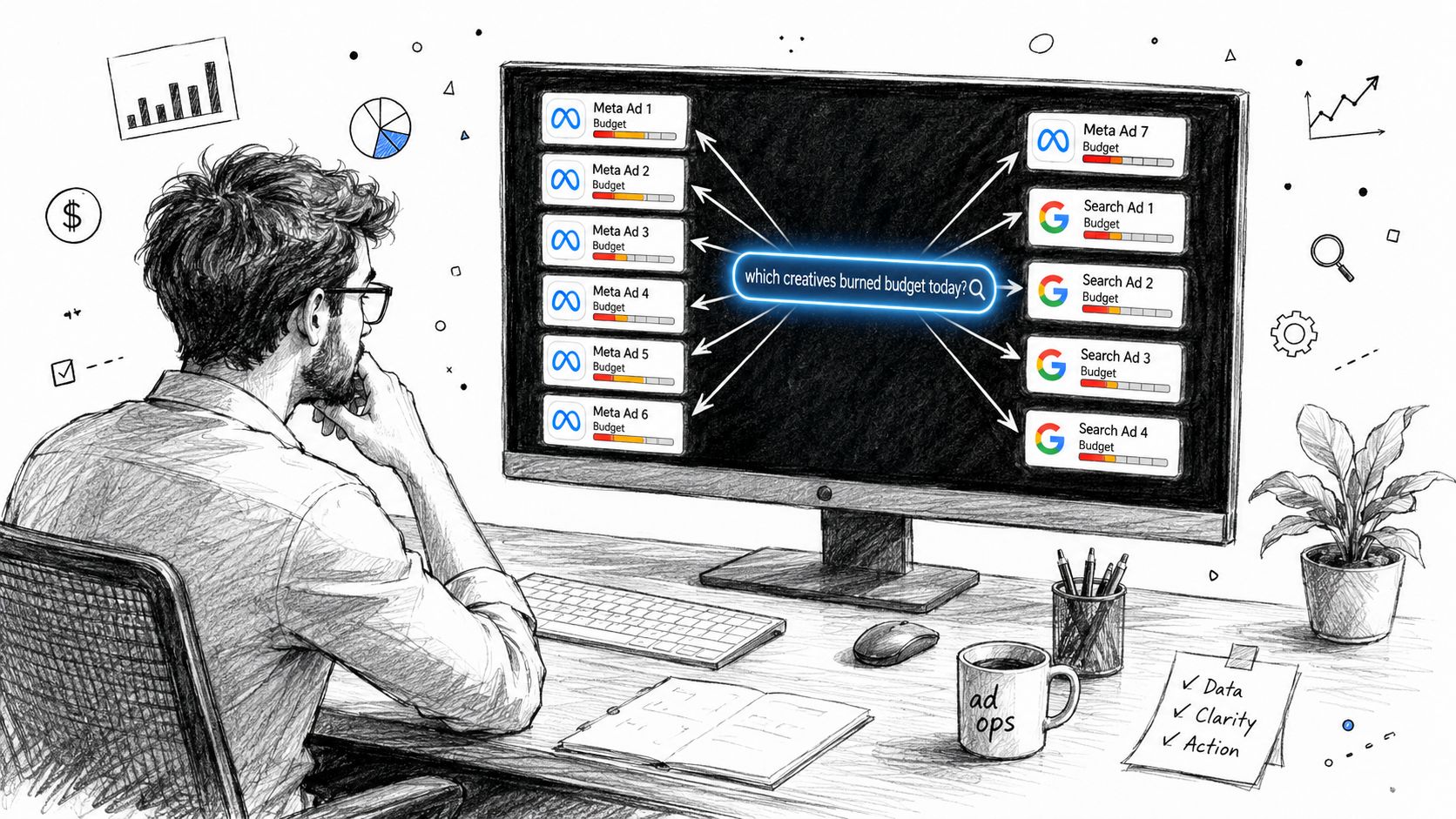
Wednesday afternoon is when a small delay becomes expensive operationally. An ad-ops lead sees CPA drifting across several Meta accounts and paid search, then asks one question:
Which creatives spent today without converting, and draft a pause for each?
The agent doesn’t jump straight to a kill switch. It reads the connected account structures, identifies eligible ads, fetches delivery data, excludes protected campaigns, and places candidate actions into a review queue. The operator sees the account, ad, observed signal, proposed status change, and reason in one place.
What the workflow checks
A useful triage request becomes safe only after the operator supplies the missing boundaries:
- Spend threshold: Don’t evaluate an ad that has barely delivered. The threshold should reflect the account’s decision policy, not a generic default.
- Lookback window: Define whether “today” means current-day delivery, a recent rolling period, or a fixed comparison window.
- Result definition: Specify what counts as a conversion and which attribution view governs the decision.
- Exclusions: Keep branded search, launch campaigns, tests, and other protected activity outside the pause set.
- Action state: Create a paused draft first, then require explicit approval for the write.
The agent can fan one question into per-account checks, compare spend with results, apply the kill policy, and stage pause_ad actions. The human then clears the queue rather than opening each account, locating each ad, and repeating the same navigation.
The efficiency comes from removing deferred action. A problem noticed on Tuesday shouldn’t wait until Thursday because the operator had to visit every account separately. Four clicks per ad may be trivial once. Multiplied across eleven other accounts and an interface that logs users out, the delay becomes the operational failure.
The second useful workflow is campaign construction from an approved plan. The agent creates the campaign, ad sets, creatives, and ads, but the result arrives paused. The plan remains the source of intent, while the activity log records the implementation.
Review the proposed actions before the write, then inspect the permanent record afterward. The video below shows the kind of performance-oriented interaction that makes this workflow understandable to operators.
The metric worth watching isn’t commentary volume or a claimed number of hours saved. It is time-to-action, the timestamp interval between a problem appearing in the data and the approved change landing on the account.
Why Trust Is the Binding Constraint
Model quality isn’t the first barrier to live-spend automation. Trust is. A client will care less about whether an agent produced a polished explanation than whether the operator can show exactly what it touched, why it touched it, and how the team can reverse the change.
Three mechanics need to exist before feature counts become meaningful.
A permanent record
Every read and write should create an append-only audit entry containing the account, exact change, request origin, actor, and outcome. The record should preserve the before-and-after state or enough information to reconstruct the difference.
That catches a mis-paused ad set, a budget edit that lacked approval, and a creative action based on stale or malformed data. It also turns time-to-action into a timestamp comparison rather than an estimate.
Paused-by-default creation
Creation and activation are separate permissions. An agent can build a campaign, ad set, creative, or ad, but the new entity should arrive paused until a human reviews the structure, destination, naming, budget, and creative.
This guardrail catches errors before they become delivery. It also keeps the operator in control of launch intent without forcing the team to assemble every object manually.
No hard deletes
Deletion removes context and weakens rollback. A paused or archived entity preserves the operational history needed to understand what happened, while a hard delete can make a later investigation depend on incomplete platform records.
Trust isn’t a policy document. It’s the architecture that decides which verbs can run without approval.
Adding an audit trail after the agent already has broad write access is theater. The log must be part of the action path, not a report generated later from whatever traces survived. Likewise, a paused-by-default wrapper must sit around creation from the beginning, not appear after an accidental launch exposes the risk.
The judgment itself also remains human. Whether an account should be pushed or protected during a particular month depends on client relationships, inventory, cash flow, and business priorities. CPA is evidence. It isn’t the whole decision.
Where AI Creates Real Leverage in Media Buying
The practical advantage appears in the short interval after a signal becomes clear and before someone changes the account. The agent doesn’t create value by writing another recommendation. It creates value by preparing a bounded correction that an operator can verify and approve.
| Friction Point | Bounded Verb | Trigger Signal | Human Checkpoint |
|---|---|---|---|
| Budget imbalance between ad sets | adjust_budget |
Delivery and efficiency diverge from the approved allocation | Confirm caps, protected tests, and client priorities |
| Underperforming creative | pause_ad |
Spend rises without the required result within the approved window | Check attribution, learning context, and exclusions |
| Resuming a recovered ad | enable_ad |
Performance returns to an approved operating range | Confirm the recovery isn’t caused by incomplete data |
| Naming and account context | append_label |
Entity lacks the required operational label | Approve taxonomy changes before broader rollout |
| Cross-platform pacing review | read_insights |
Meta, Google Ads, and TikTok show inconsistent delivery patterns | Decide whether the platforms are comparable |
| Creative preparation | draft_creative |
A Campaign Plan contains approved creative requirements | Review brand, claims, destination, and format |
Budget movement is useful when the signal and the authority are both clear. The agent can compare delivery against the approved plan, propose an adjust_budget action, and hold it for approval. It shouldn’t infer that a short-term result warrants unlimited scaling.
Pausing waste is more direct. A lead can ask which ads are over CPA across connected accounts, inspect the evidence in one session, and stage only the eligible Meta writes. The improvement comes from reducing the delay between diagnosis and action, not from producing a prettier explanation.
Cross-platform consistency is harder because reading across Meta, TikTok, and Google Ads doesn’t make their attribution, campaign structures, or optimization objectives identical. A unified read layer helps operators compare context, but the human still decides whether a discrepancy represents a real pacing problem or a measurement mismatch.
That distinction keeps the speed honest. Every useful action still depends on a bounded verb, a defined signal, an explicit checkpoint, and a record of the outcome. Without those controls, automation merely hides manual judgment inside an opaque process.
When You Should Avoid Full Automation
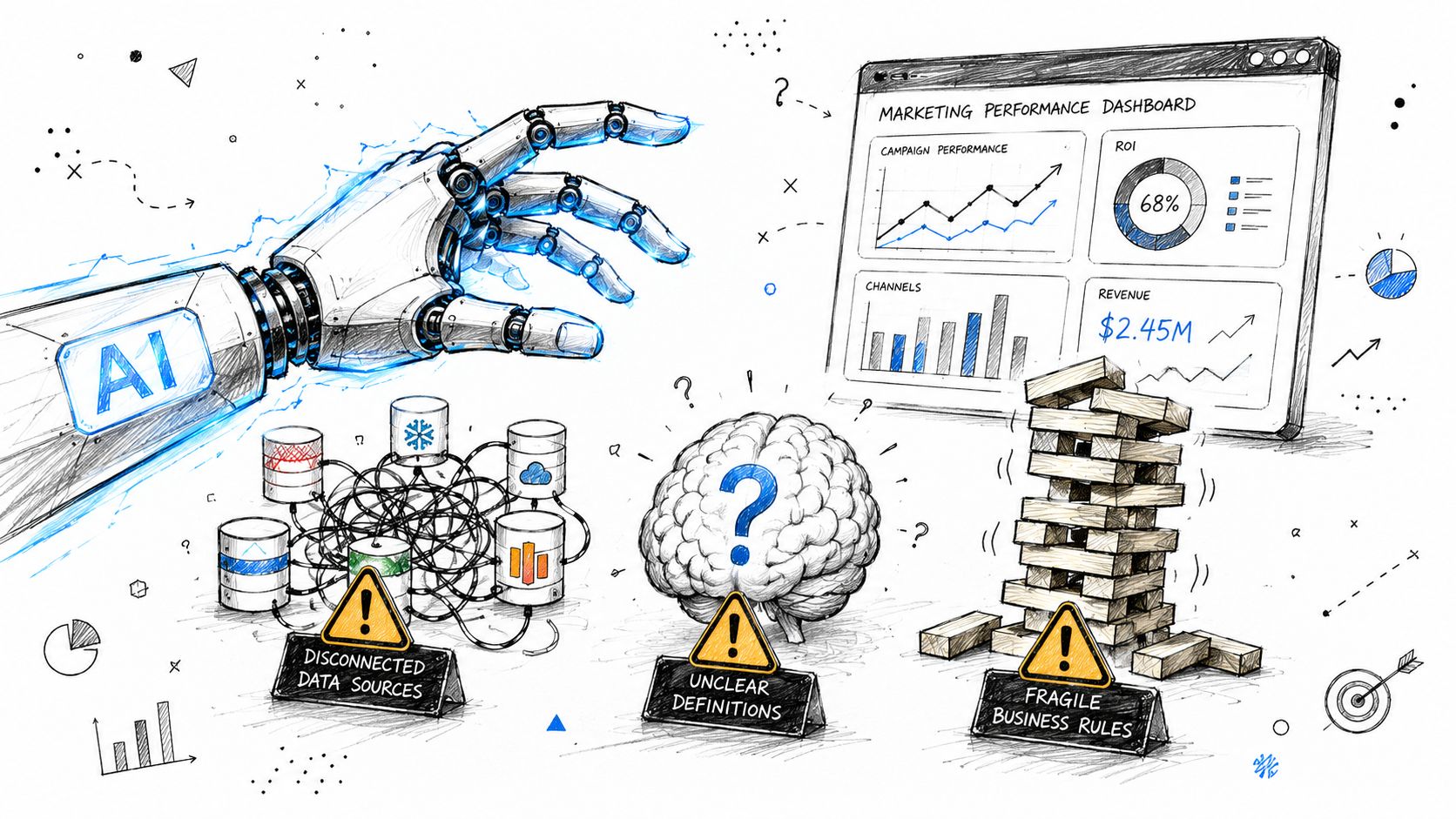
“Automate everything” is a poor operating principle when the measurement system can’t explain what happened. An agent can execute quickly against fragmented inputs, but speed doesn’t repair contradictory definitions, incomplete integrations, or uncertain attribution.
Fragmented data warehouses
If spend, conversion, revenue, and account metadata live in disconnected systems with no canonical source of truth, the agent may rank entities using partial evidence. The safe footprint is read-only diagnostics, source-by-source comparisons, and flagged discrepancies.
Don’t grant budget or status writes until the team agrees which dataset governs the decision and how stale values are handled. A clear limitation is safer than a confident action based on mixed records.
Weak cross-platform measurement
Meta, TikTok, and Google Ads may report different views of performance. If the attribution stack can’t resolve cross-platform incrementality, an agent shouldn’t automatically move money between networks merely because one dashboard shows a stronger return.
Use read_insights to surface anomalies and prepare a recommendation. Require a human to approve any cross-platform allocation change after checking attribution windows, branded activity, and business context.
Unvalidated product launches
A new product launch often combines uncertain creative direction, changing offers, and incomplete conversion signals. Automating creative selection or budget escalation before the team validates the message can turn an experiment into a scaled mistake.
Start with drafts, paused entities, explicit approval, and a narrow observation process. The operational case for Meta Ads automation is strongest when repetitive execution is bounded, not when strategic uncertainty is disguised as a workflow.
The broader market reflects this maturity gap. One recent benchmark reports that 67% of B2B teams use AI in at least one workflow, while only 23% have implemented it across the entire marketing automation stack (AI marketing automation implementation benchmark). That isn’t a reason to force full coverage. It supports selective deployment where the data, approval path, and rollback mechanics are strong.
Choosing a Vendor Worthy of Live Spend
The next competitive edge won’t come from the fastest model alone. It will come from the tighter audit trail and the narrower permission surface. A vendor earns the right to write to live spend when its controls are visible to operators, not buried in a sales demo.
Look for three signals.
- Durable action records: Every change should show the actor, intent, exact diff, account, result, and rollback path. “The agent optimized the campaign” isn’t an audit entry.
- Paused-by-default creation: A system may build campaign objects from an approved plan, but promotion to active delivery should require explicit approval.
- A disclosed verb set: The vendor should state exactly what the agent can read and write, then expose rate limits, spend caps, approval gates, and cooldown controls that a human can tighten without engineering work.
Marketing-operations guidance also treats auditability as a core workflow requirement, with prompts, versions, approvals, and outcomes retained in an audit trail alongside throttles, suppression rules, cooldown windows, and anomaly auto-pausing (safer AI marketing workflows).
Ask to see the failure path, not just the happy path. What happens when data is stale? Can the operator reject one action while approving another? Does the system preserve the original value before changing a budget? Can a client see the complete history without reconstructing it from screenshots?
For teams comparing ad-ops tools, the central evaluation question is straightforward: what may this platform write, under whose authority, and with what evidence afterward? A smaller, transparent action surface is more useful than an impressive feature list that gives an agent vague control over delivery.
AdCrunch connects Meta, TikTok, and Google Ads for consistent account and performance reads, while its Meta write layer supports bounded operational actions and records activity in a permanent log. That makes it an example of the permission-first approach, not a replacement for human judgment about client strategy.
AdCrunch connects your advertising accounts to Claude, ChatGPT, Cursor, and its in-console agent so your team can query live performance and execute bounded Meta actions without losing the audit trail. Visit AdCrunch to review the available connections, paused-by-default writes, and activity records before putting an agent near client spend.