
AI Campaign Management: A Practical Guide for Ad Teams
Learn how AI campaign management works across Meta, TikTok, and Google Ads. Discover automation patterns, governance guardrails, and safe write actions
- ai campaign management
- ad automation
- campaign orchestration
- ai ad operations
- media buying
The most popular advice about AI in media buying is still backward. People keep treating it like a copy tool that happens to sit near ad platforms, when the actual change is happening at the execution layer, where budgets move, campaigns launch, and underperforming ads get paused. That’s where AI campaign management matters, because the value isn’t just in faster ideas, it’s in faster action with fewer mistakes.
The market is already moving in that direction. eMarketer forecast that U.S. AI ad spending would reach $32.03 billion in 2026 and $68.25 billion by 2030, with more than 80% of 2026 spend expected to run through traditional paid search placements shown alongside AI-generated search experiences rather than inside chatbots (Forbes coverage of the eMarketer forecast). That’s a strong signal that AI in advertising isn’t staying in a sandbox. It’s moving into the same campaign systems teams already use.
Table of Contents
- Why AI Campaign Management Is Not What You Think
- How AI Agents Connect to Ad Platforms
- Common Automation Patterns in Campaign Management
- AI-Native Tools Versus Traditional Dashboards
- Designing Governance for Safe Write Actions
- Launching a Campaign End-to-End Through an AI Agent
- Building Your AI Campaign Management Stack
Why AI Campaign Management Is Not What You Think
The wrong mental model says AI campaign management means handing over the account and letting an agent run loose. That’s not how serious teams are deploying it, and it’s not how the safer systems are built. The practical version is orchestrated execution, where AI handles the repetitive mechanics and humans keep authority at the points that matter.
That distinction matters because programmatic buying already created a foundation for machine-assisted ad execution. One 2025 forecast estimated programmatic would account for 96.8% of new display ad dollars worldwide in 2025, easing to 96.0% in 2026, and another market estimate put U.S. programmatic revenue at $162.4 billion in 2025 with roughly 55% of all U.S. internet ad revenue flowing through programmatic routes (eMarketer on programmatic growth). In other words, most budgets are already moving through automated systems. AI campaign management is the next layer on top, not a separate universe.
Practical rule: let AI compress the distance between diagnosis and action, but keep humans on the commit step.
The real job is reducing lag
A media buyer feels the difference when an ad set starts slipping and the budget gets reallocated in the same conversation instead of days later. That timing edge is the useful part. It doesn’t require claiming a magic uplift, and it shouldn’t.
The ANA’s 2024 benchmark is a reminder that automation alone doesn’t solve waste. It found a 7.9% improvement in ad-spend efficiency, but only $439 of every $1,000 spent programmatically reached consumers, which means waste still sits deep in the supply path (ANA benchmark summary). So the job of AI campaign management isn’t just “optimize the ad.” It’s also to expose waste, spot it early, and stop money from drifting into poor paths.
How AI Agents Connect to Ad Platforms
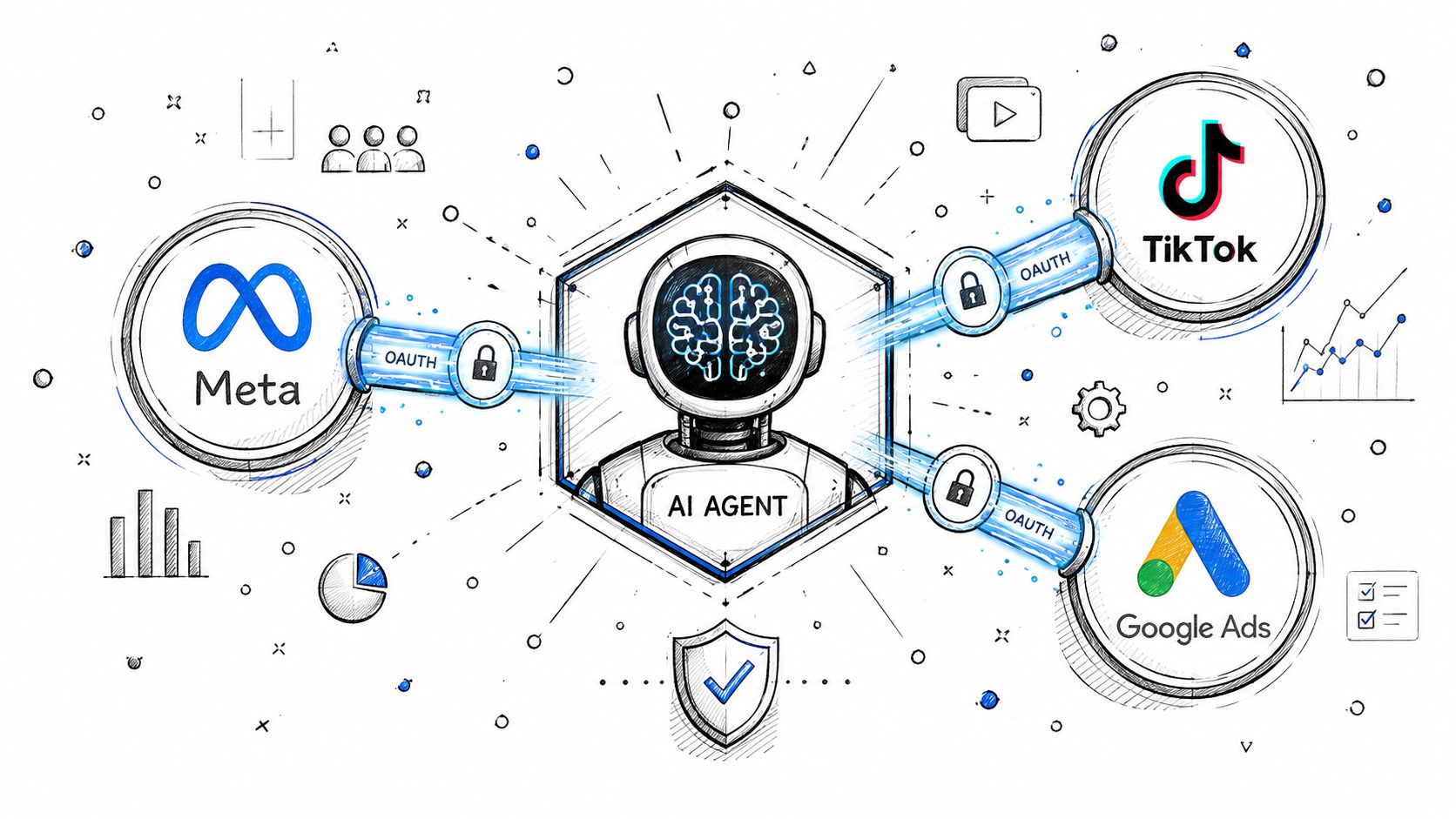
The technical model is simpler than people assume, but it has to be designed carefully. An AI agent doesn’t need to “know” your account the way a human manager does. It needs secure access, structured data, and a constrained set of actions. That usually starts with OAuth connections into platforms such as Meta, TikTok, and Google Ads, so the agent can read account structure and performance in a consistent format.
From there, the split between read access and write access matters. Read access lets the agent inspect campaigns, ad sets, creatives, budgets, and results. Write access is where risk enters, because the system can now create, pause, resume, or adjust live objects. If you expose API keys directly to an LLM, you’ve created a security problem. Credentials should stay server-side, and the model should only request actions through controlled services that enforce policy before anything reaches the ad platform.
Boundaries make the system usable
A bounded verb set is the line between a useful agent and a dangerous one. In practice, that means the agent can build campaigns, adjust budgets, or pause and resume entities, but it can’t casually hard-delete objects or rewrite targeting on live ad sets. Those limits aren’t a compromise. They’re what make the system stable enough to trust.
Credentials should never be treated like chat context. The model can reason about actions, but the platform should own execution.
The best deployments also keep the action layer auditable. That’s not just a compliance preference, it’s operational sanity. When multiple operators touch the same accounts, a permanent record of who requested what, what changed, and what happened next keeps the whole system reviewable.
Common Automation Patterns in Campaign Management
The highest-value pattern I see is not “run everything on autopilot.” It’s “answer the question, then act immediately.” Teams ask the agent what’s working across accounts, then move spend, pause weak ads, or build a new structure while the context is still fresh. That’s a very different operating rhythm from dashboards that leave the team to interpret data, write notes, and come back later to make the change.
Campaign building from structured plans is the other pattern that consistently works. When a media plan already has an objective, budget, dates, targeting shape, and creative direction, the agent doesn’t need to invent the strategy. It just needs to translate approved intent into platform objects. That keeps the human work where it belongs, in planning, not in repetitive clicking.
A lot of teams ask for scheduled autonomy because it sounds efficient. In practice, on-demand execution is often cleaner.
What works: ask, review, act.
What doesn’t: let an agent roam on a loop when the creative, audience, or seasonality context changes quickly.
Timing beats theoretical uplift
One hard lesson is that I don’t trust a claimed uplift unless I can separate it from seasonality and creative fatigue. That’s why some teams don’t run agents on an autonomous daily schedule. If the agent only acts when someone asks it to, the value is easier to defend. The gain is timing, not a hand-wavy performance claim.
The autonomous-campaign research points in the same direction. A multi-agent system using LLM reasoning and direct API execution reported 30% to 60% higher average ROAS and 25% to more than 70% reduction in wasted ad spend versus manual baselines, while also noting that results vary with campaign complexity and data quality (autonomous ad-campaign system paper). That’s the key takeaway, closed-loop execution can outperform manual workflows when the inputs are clean and the write path is fast. It can also fail badly when signals are noisy.
AI-Native Tools Versus Traditional Dashboards
A traditional dashboard is good at reporting. It shows spend, clicks, trends, and maybe a few alerts. It doesn’t move a budget, pause a bad ad, or build a campaign from an approved plan. An AI-native tool goes further, it connects the networks and performs the operational work, while keeping a review layer around the actions.
That difference matters most for teams juggling multiple ad accounts. Dashboards fragment attention across tabs, exports, and comments. AI-native systems reduce that switch cost by using one connection shape across networks, then letting the operator ask a question and execute the answer in the same flow. That’s not just convenience. It reduces context loss, which is where a lot of account mistakes come from.
Pricing also changes the decision. Per-account and per-seat billing punishes small clients and makes instrumentation feel expensive before it proves useful. Flat per-organization pricing is easier to justify when the goal is to standardize workflows across many accounts.
| Capability | Traditional Dashboard | AI-Native Tool |
|---|---|---|
| Reading performance | Yes | Yes |
| Moving budget | No | Yes |
| Pausing or resuming campaigns | No | Yes |
| Building campaigns from a plan | No | Yes |
| Cross-account workflow | Limited | Built in |
| Action audit trail | Usually limited | Designed in |
Where dashboards still make sense
Dashboards still belong in the stack when the team only needs visibility or a lightweight reporting layer. They’re fine for monitoring, stakeholder updates, and quick checks. They’re not enough when the team wants to act without handoffs.
One practical option in this category is AdCrunch, which connects Meta, TikTok, and Google Ads to AI agents and keeps changes on a permanent activity log. It sits on the action side of the stack, not just the reporting side, so the difference is immediate.
Designing Governance for Safe Write Actions
Governance is the part many underbuild, then regret later. The safest pattern is boring on purpose. Everything created starts paused, nothing deletes hard, and any action that changes spend or account structure goes through a controlled approval path. That sounds conservative until you’ve seen an agent publish something live before brand review.
Pausing as the default is standard platform behavior too. Meta campaign controls allow a campaign to be set to Enable or Pause from the Campaigns view, and pausing is the normal way to hold delivery without deleting the object outright (Google Ads support on campaign status controls). Meta’s hierarchy also matters, because pausing a campaign pauses the ad sets and ads beneath it (Meta pause hierarchy guidance). If your workflow respects that hierarchy, you can review once at the top and still control downstream delivery.
Review the plan once. Don’t review twenty separate writes.
Approval belongs at the plan level
The cleanest workflow is approval at the Campaign Plan level, not at each API call. A person can read a structured document with objective, budget, dates, targeting shape, and creative, then approve that plan once. After that, the agent should execute within the bounds of the plan instead of asking for permission on every click.
That structure is stronger than procedural oversight because it prevents drift before it starts. A human doesn’t need to approve every reversible step. The human needs to approve the intent, then inspect the result before anything goes live.
The human-in-the-loop rule is simple. If an action is hard to undo, pause for confirmation. If the action is reversible, let the agent do the prep work. One documented HITL pattern describes exactly that, autonomous reversible steps followed by single-click approval before the final write (HITL agentic scheduling pattern). That’s the right model for ad ops too.
Launching a Campaign End-to-End Through an AI Agent
The first end-to-end launch I’d trust through an AI agent is one where the campaign plan was already approved before the agent touched the account. In one clean build, the agent can assemble a Meta campaign, one ad set, and one ad from a registered asset library, while the strategist keeps control of the brief and the guardrails. That is the part that matters in practice. The human approves intent, the agent handles assembly.
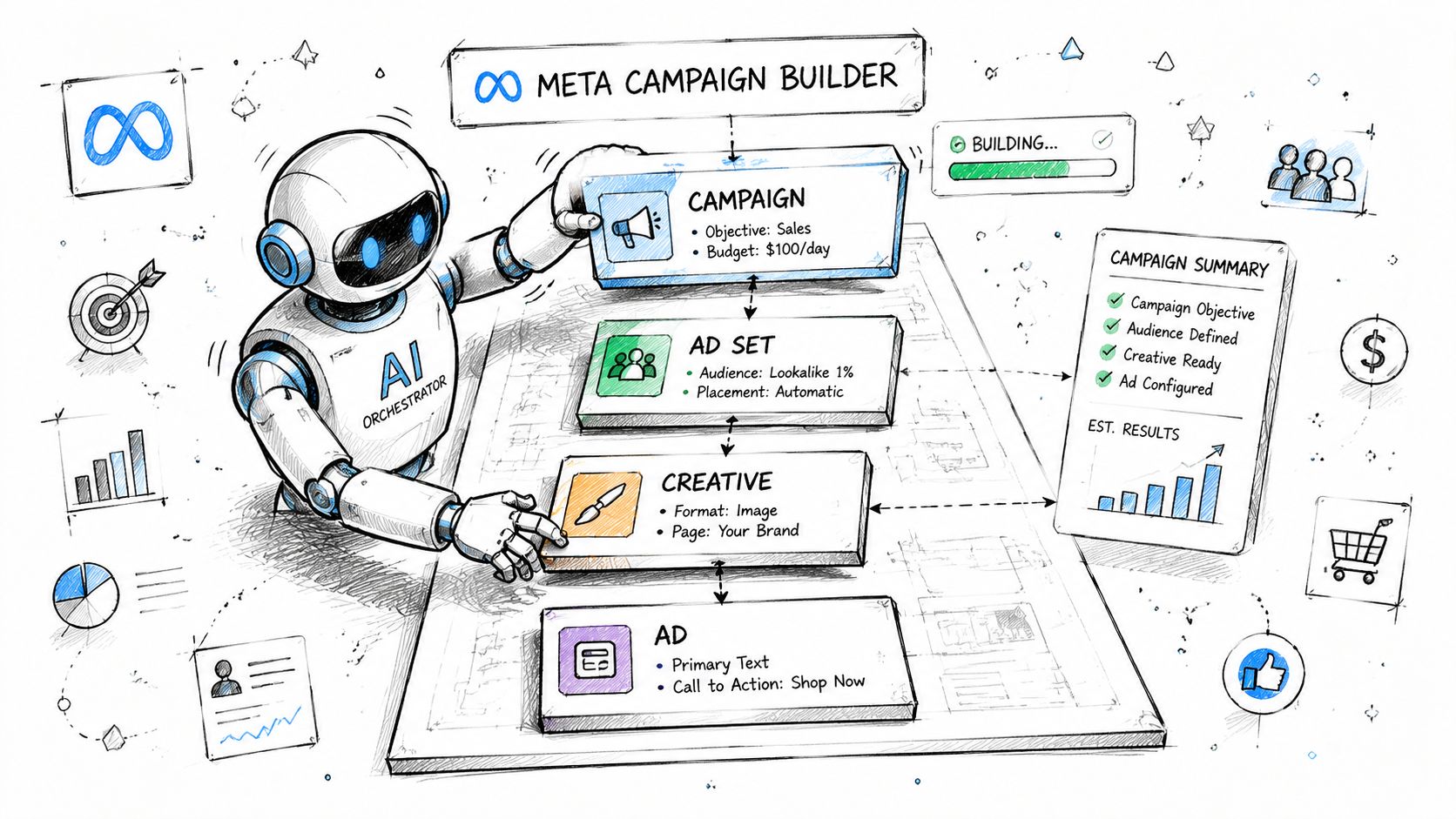
The launch should still arrive paused. Nothing should start spending until someone reviews the build, checks the naming, and confirms the campaign matches the approved plan. That pause is not a delay, it is the control point.
For a deeper walkthrough of wiring agents to platform actions, see this guide on AI marketing automation. If you are mapping write actions to platform structure, This AdCrunch guide on Meta Ads automation is a useful companion. The point is simple. A launch is not finished when the objects exist. It is finished when the objects are approved, paused, and ready for a human commit.
Stored guidelines beat prompt memory
Brand guidance should not live only in a one-off prompt. If you type tone, exclusions, and positioning into a conversation, it may work for that session, then drift the next time. That is a workflow problem.
Store Brand rules and house playbooks in persistent Skills so the agent reads them every time before it acts. That keeps outputs steadier across sessions and cuts the need to restate the same constraints over and over. It also keeps strategy separate from execution, which matters once real write access is on the line.
Building Your AI Campaign Management Stack
The right stack starts with readiness, not with automation hype. If your data is messy, your workflows are undocumented, or your governance is weak, autonomy will amplify the problems you already have. The first question is whether the team can trust the inputs and review the outputs without creating extra friction.
The second question is what kind of autonomy fits the account. For many teams, on-demand agent execution is the right place to start because it keeps a person in the loop while still shortening the time from insight to action. Scheduled autonomy only makes sense once the data quality is stable, the approval rules are explicit, and the audit trail is mature enough to support it.
Programmatic still leaks waste at scale, so a good stack should watch spend allocation at the line-item level, not just the campaign-summary level (ANA benchmark summary). That’s where AI can help the most, by spotting low-yield paths and surfacing them before the budget compounds in the wrong place.
This AdCrunch overview of ad ops tools is a good reference if you’re comparing how different systems fit into the stack.
A practical adoption sequence
- Start read-only: connect accounts, inspect structure, and validate that reporting matches platform reality.
- Add bounded writes: allow campaign creation, budget changes, and pauses, but keep creations paused and preserve a permanent audit trail.
- Expand autonomy carefully: only move toward scheduled or broader action sets after the team proves that approvals, logs, and rollback paths are reliable.
The teams that win with AI campaign management don’t chase full autonomy first. They build a controlled system that gets faster without getting careless.
If you want a practical way to connect AI to live campaign work without losing control, AdCrunch gives teams structured plans, bounded write actions, and a permanent activity log across Meta, TikTok, and Google Ads. Visit AdCrunch to see how an AI-native ad operations workflow fits into your current stack.